Free Independent Contractor Invoice Template
An independent contractor invoice template for 1099 workers billing clients for services. Download it free in Word, Excel, PDF, Google Docs, or Google Sheets, add your services and hours, and include your EIN so clients can issue your 1099-NEC. Designed for contractors who handle their own taxes - it gives you a clean income record for Schedule C and your quarterly estimated payments.
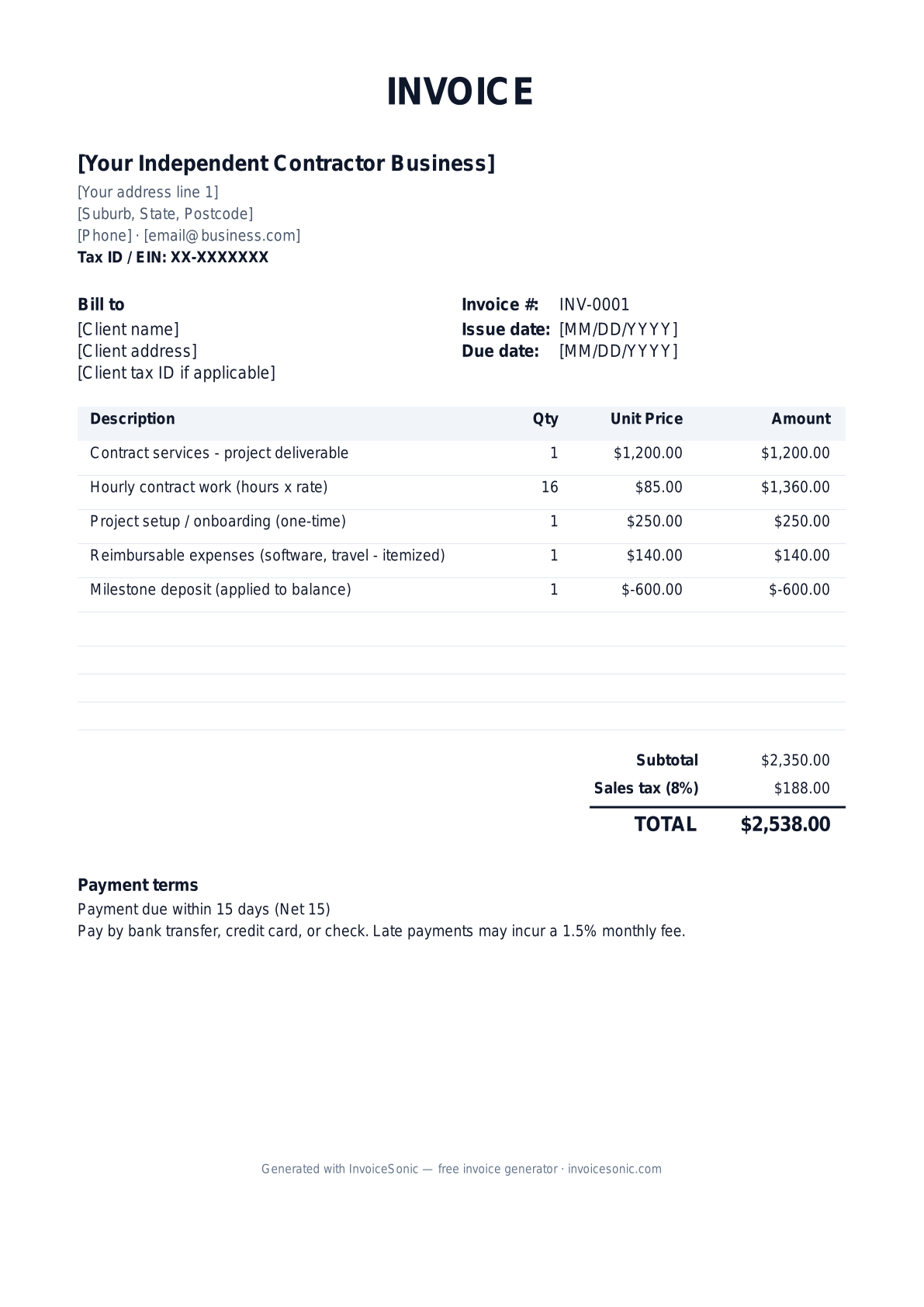
Download the independent contractor invoice template
Or build it online in 60 seconds
Use InvoiceSonic's free generator — auto-calculate tax, prefill your details, and email the PDF straight to your client. No formatting needed.
Try the live generator →What's on the independent contractor invoice template
| Description | Qty | Unit price | Amount |
|---|---|---|---|
| Contract services - project deliverable | 1 | $1,200.00 | $1,200.00 |
| Hourly contract work (hours x rate) | 16 | $85.00 | $1,360.00 |
| Project setup / onboarding (one-time) | 1 | $250.00 | $250.00 |
| Reimbursable expenses (software, travel - itemized) | 1 | $140.00 | $140.00 |
| Milestone deposit (applied to balance) | 1 | $-600.00 | $-600.00 |
| Subtotal | $2,350.00 | ||
| Sales tax (8%) | $188.00 | ||
| Total | $2,538.00 | ||
Example figures — every field is editable in the download.
Who uses this template
- ✓1099 independent contractors in any field
- ✓Freelance developers, designers, and writers under contract
- ✓IT, marketing, and operations consultants billing per engagement
- ✓Tradespeople and service providers working as non-employees
- ✓Gig and project workers who handle their own taxes and benefits
What to include
- ✓Your name or business name, address, and contact info
- ✓Your EIN (preferred) or SSN for the client's 1099-NEC
- ✓Client/company name and billing address
- ✓Invoice number, issue date, and contract or PO reference
- ✓Itemized services with hours or quantities and rates
- ✓Reimbursable expenses listed separately from labor
- ✓Subtotal, total due in USD, payment terms, and methods
Available in 5 formats
Word (.docx)
Fully editable in Microsoft Word, Google Docs, Apple Pages and LibreOffice — best for quick text edits.
Excel (.xlsx)
Line totals, subtotal and tax calculate automatically — best if you want the math done for you.
A clean, print-ready, fixed layout — best for emailing a finished invoice to a client.
Google Docs / Sheets
Open in your browser, then File → Make a copy to edit and share with your team.
Invoicing tips for independent contractor
- ✓ Provide a completed W-9 to clients once a year so they have your EIN on file for 1099-NEC reporting.
- ✓ Use your EIN instead of your SSN on invoices and the W-9 to protect your personal information.
- ✓ Track every invoice as Schedule C income and reserve 25-30% for income and self-employment tax.
- ✓ List reimbursable expenses separately from your labor so they're easy to identify and account for.
- ✓ Reference the contract or PO number on each invoice to speed up your client's approval and payment.
Independent Contractor invoice FAQ
What's the difference between an independent contractor and an employee for invoicing?
An independent contractor bills clients with invoices, receives a 1099-NEC (not a W-2), and pays their own income and self-employment taxes. Employees are paid through payroll with taxes withheld. As a contractor, your invoices are your primary income record.
Do I need to give clients a W-9?
Yes. Clients who pay you $600 or more in a year need your W-9 to issue a 1099-NEC. Provide it at the start of the engagement. List your EIN on the W-9 to keep your SSN private while still meeting the reporting requirement.
Will I get a 1099 for every invoice I send?
Not per invoice. A client issues one 1099-NEC at year-end totaling all payments to you if they paid you $600 or more. Keep your own invoice records, since you must report all contractor income even if you don't receive a 1099.
How do independent contractors handle taxes?
You report invoice income on Schedule C and pay both income tax and the 15.3% self-employment tax. Make quarterly estimated payments to the IRS (and your state) to avoid underpayment penalties, and set aside roughly 25-30% of each payment.
Related invoice templates
Prefer a specific format? Word invoice template · Excel invoice template · PDF invoice template · Google Docs invoice template · All invoice templates