Free Electrical Invoice Template & Generator
Electrical jobs span quick repairs, full installs, and scheduled safety inspections, and your invoice should make clear exactly what the customer is paying for. Break it down into labour hours at your rate, materials such as cabling, switchboards, power points and fittings, plus any certificate or compliance fees, so nothing looks like a hidden mark-up. Where you have issued a Certificate of Compliance or a safety inspection report, reference it on the invoice; it is both a selling point and a record. Including your electrical licence number gives clients confidence the work meets standard. If you are GST registered, show the 10 percent separately and include your ABN, and state your terms, whether that is on completion for small jobs or net 14 for commercial clients. Build a tidy, professional electrical invoice free with InvoiceSonic using the ready template and generator, then download it as a PDF without signing up.
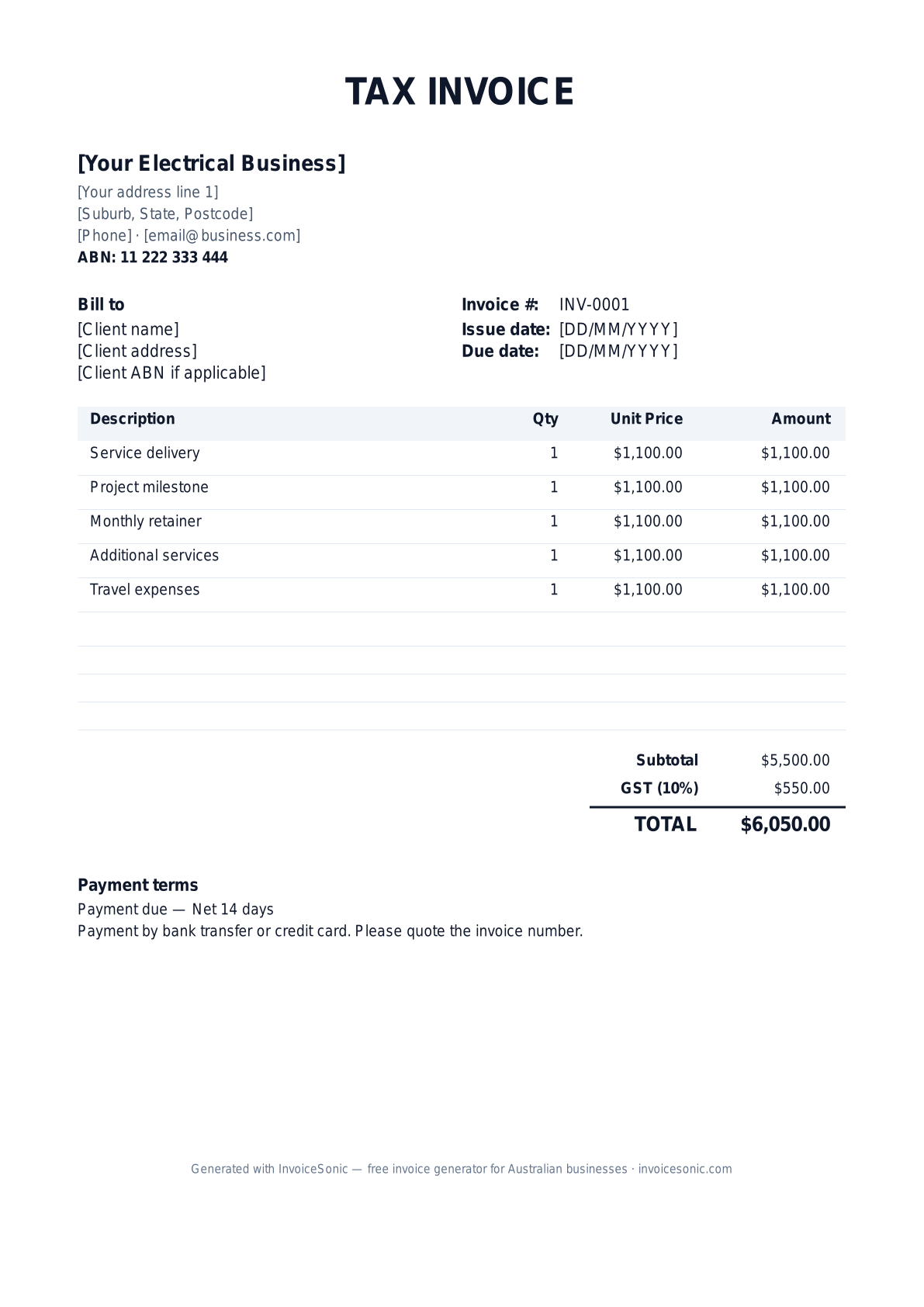
Preview of the electrical invoice template — create or download yours free.
Why Electrical Professionals Choose InvoiceSonic
Industry-specific invoicing tools designed for Electrical
Industry-Specific Templates
Pre-built templates tailored for Electrical with common line items and payment terms.
Fast Invoice Creation
Create professional Electrical invoices in under 2 minutes with our streamlined interface.
GST Compliant
Automatic GST calculations ensure your Electrical invoices meet Australian tax requirements.
Professional Branding
Add your logo and customize colors to match your Electrical business brand.
Client Management
Keep track of all your Electrical clients and their payment history in one place.
Recurring Billing
Perfect for Electrical businesses with ongoing service contracts and subscriptions.
Common Services for Electrical
Typical services you can include on your Electrical invoices:
- ✓ Power point & lighting install
- ✓ Switchboard upgrades
- ✓ Safety switch testing
- ✓ Smoke alarm compliance
- ✓ Commercial fit-out wiring
Average Invoice Value: $5500 | Payment Terms: Net 14 days
Typical Line Items on Electrical Invoices
Common billable items electrical businesses include on invoices:
- ✓ Labour — electrician (hourly)
- ✓ Materials — cable, switches, fittings
- ✓ Compliance test & certificate
- ✓ After-hours call-out
- ✓ EV charger installation
Invoicing Tips for Electrical
- ✓ Reference the electrical compliance certificate number on the invoice
- ✓ Quote and invoice separately for inspection vs remedial work
- ✓ Use progress invoices on large commercial jobs aligned to milestones
- ✓ Note if work is exempt or zero-rated where applicable
Electrical invoicing software — beyond the paper invoice book
Sparkies get pitched two extremes: enterprise field-service systems (simPRO, AroFlo — powerful, priced and configured for contracting firms) or the old duplicate invoice book. In between sits what most independent electricians actually need: fast, compliant invoicing from the phone or ute between jobs.
The billing specifics electrical work needs: your electrical contractor licence number on every invoice, call-out fee as its own line item, parts vs labour itemised, GST shown correctly, and — for compliance work — a note referencing the certificate of electrical safety issued. A dedicated invoicing app handles all of that at $0–$19/month. Try it with the free invoice generator, or compare the options in our 2026 Australian ranking.
- ✓ Electrical contractor licence number on every tax invoice
- ✓ Call-out fees, parts and labour as clean separate line items
- ✓ Reference certificates of electrical safety on compliance jobs
- ✓ Invoice on-site from your phone — get paid before the next job
Common Electrical Invoicing Mistakes to Avoid
- ✓ Not separating inspection fee from repair work on the same visit
- ✓ Missing electrical contractor licence details where mandated
- ✓ Invoicing materials at retail without showing quantity and unit price
- ✓ Omitting GST on domestic installs for GST-registered contractors
Electrical Invoicing FAQ
What should I include on a Electrical invoice?
Your Electrical invoice should include your ABN, business details, client information, detailed line items for services or products, payment terms (typically Net 14 days), GST breakdown, and total amount due.
How do I price my Electrical services?
The average invoice value for Electrical is $5500. Consider your experience, market rates, overhead costs, and the value you provide when setting prices for your services.
What payment terms are standard in Electrical?
Most Electrical businesses use payment terms of Net 14 days. However, you can adjust based on your relationship with the client and cash flow needs.
Can I create recurring invoices for Electrical clients?
Yes! InvoiceSonic allows you to set up recurring invoices for regular Electrical clients. This is perfect for ongoing contracts, maintenance agreements, or subscription-based services.
What is the best invoicing app for electricians in Australia?
Contracting firms running teams typically use simPRO or AroFlo (enterprise field-service pricing). Independent sparkies who need compliant invoices fast are better served by a dedicated invoicing app: InvoiceSonic creates GST-ready tax invoices with your licence number free (no signup), with recurring billing and branding at $19/month.
What must an electrician's invoice include in Australia?
A GST-registered electrician's tax invoice needs the standard ATO elements (the words 'Tax Invoice', ABN, date, description, GST amount) plus your electrical contractor licence number — required on advertising and documents in most states — and ideally the certificate of electrical safety reference for notifiable work.
Electrical Invoice Template — Locations & Related
Electrical by city (AU)
- Electrical invoices in Sydney
- Electrical invoices in Melbourne
- Electrical invoices in Brisbane
- Electrical invoices in Perth
- Electrical invoices in Adelaide
- Electrical invoices in Gold Coast
- Electrical invoices in Canberra
- Electrical invoices in Newcastle
- Electrical invoices in Wollongong
- Electrical invoices in Hobart
- Electrical invoices in Geelong
- Electrical invoices in Townsville
- Electrical invoices in Cairns
- Electrical invoices in Darwin
- Electrical invoices in Toowoomba
- Electrical invoices in Ballarat
- Electrical invoices in Bendigo
- Electrical invoices in Albury
- Electrical invoices in Launceston
- Electrical invoices in Mackay
- Electrical invoices in Rockhampton
- Electrical invoices in Bunbury
- Electrical invoices in Bundaberg
- Electrical invoices in Coffs Harbour
- Electrical invoices in Wagga Wagga
- Electrical invoices in Hervey Bay
- Electrical invoices in Mildura
- Electrical invoices in Shepparton
- Electrical invoices in Port Macquarie
- Electrical invoices in Gladstone
- Electrical invoices in Tamworth
- Electrical invoices in Traralgon
- Electrical invoices in Orange
- Electrical invoices in Geraldton
- Electrical invoices in Bowral
- Electrical invoices in Dubbo
- Electrical invoices in Nowra
- Electrical invoices in Bathurst
- Electrical invoices in Warrnambool
- Electrical invoices in Kalgoorlie
- Electrical invoices in Lismore
- Electrical invoices in Alice Springs
Electrical by country
Other industries
- Construction invoice template
- Graphic Design invoice template
- Web Development invoice template
- Marketing Consulting invoice template
- Photography invoice template
- Accounting & Bookkeeping invoice template
- Plumbing invoice template
- Cleaning Services invoice template
- IT Support invoice template
- Landscaping invoice template
- Carpentry invoice template
- Interior Design invoice template
- Pest Control invoice template
- HVAC Services invoice template
- Painting & Decorating invoice template
- Content Writing invoice template
- Video Production invoice template
- Event Planning invoice template
- Real Estate Services invoice template
- Legal Services invoice template
- Architecture invoice template
- Engineering Consulting invoice template
- Property Management invoice template
- Mobile App Development invoice template
- Digital Marketing invoice template
- SEO Services invoice template
- Social Media Management invoice template
- Translation Services invoice template
- Tutoring invoice template
- NDIS Services invoice template
- Roofing invoice template
Need a different format? Browse our complete template library or try our free invoice generator.
A practical guide to electrical billing
Use the template as a starting layout, then replace its example information with the actual agreed work. The details below help you decide what to enter and what to check before sending.
Agree what this invoice covers
Separate fault finding from the authorised repair or installation. Identify the equipment, circuits or areas included in the accepted scope. If diagnosis reveals additional work, record the customer’s approval before adding it to the invoice.
Give the payer enough context
Include the service address, job number, visit date and relevant equipment or circuit reference. Check the legal billing name and delivery contact against the accepted work. Keep the approved scope, labour record, parts schedule and relevant completion-document references available to resolve questions. An invoice records the charge; it does not replace the underlying approval or supporting documents.
Worked electrical invoice example
Diagnosis, supplied parts and installation are visible as separate charges. This is a billing example, not a technical safety checklist; required certificates and inspections remain separate from the invoice.
| Description | Quantity | Rate | Amount |
|---|---|---|---|
| Fault-finding labour | 2 | 90.00 | 180.00 |
| Replacement fitting — approved supply | 3 | 45.00 | 135.00 |
| Installation labour | 1 | 90.00 | 90.00 |
| Example subtotal | 405.00 | ||
Avoid this billing mistake
Grouping all fittings into ‘materials’ makes quantities difficult to verify. Use a clear description and quantity, and distinguish a supplied item from labour that was already included in the quoted installation price.
Follow up on the right record
Send the invoice to the party responsible for the approved work, which may differ from the site contact. If payment is waiting on a completion document, confirm the missing reference and provide it through the appropriate process.
Before you send
- Match the line items and quantities to the accepted scope and approved changes.
- Check the invoice number, issue date, explicit due date and the service address, job number, visit date and relevant equipment or circuit reference.
- Apply only the tax treatment relevant to your business and location; check current local requirements if unsure.
- Keep earlier billing separate from actual payments. Verify the outstanding amount and payment instructions.
The free browser tool prepares the document. Saving customers, sending tracked invoices and managing reminders require an account and are subject to plan limits. Payment status needs accurate payment records; an invoice view alone does not confirm payment.