Free Content Writing Invoice Template & Generator
Content writers juggle a mix of billing models, and a clear invoice keeps that mix legible to clients. Whether you charge per word, per article, or on a monthly retainer, your invoice should itemise each deliverable by title with its agreed word count, so an editor can match the line to the brief. Spell out revision rounds included and any SEO scope, such as keyword targeting or meta descriptions, since these often blur into scope creep when undocumented. Australian writers registered for GST should show the 10 per cent separately and list their ABN, while sole traders below the threshold simply note they are not registered. Net 14 or net 30 are common terms for editorial work, and stating yours upfront speeds payment from busy content teams. You can create a professional, tidy invoice for free with InvoiceSonic, using the template and generator to produce a PDF with no signup required.
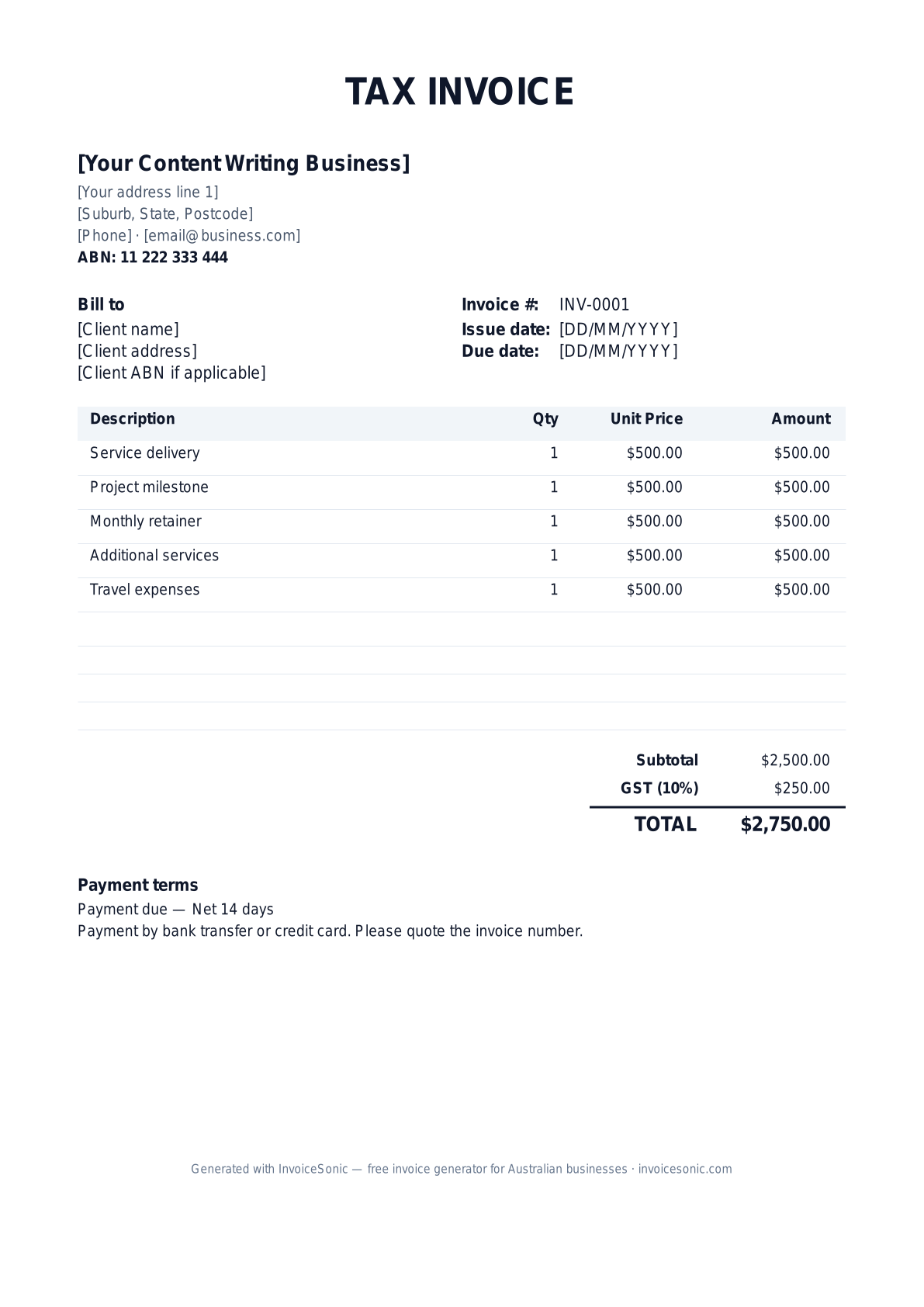
Preview of the content writing invoice template — create or download yours free.
Why Content Writing Professionals Choose InvoiceSonic
Industry-specific invoicing tools designed for Content Writing
Industry-Specific Templates
Pre-built templates tailored for Content Writing with common line items and payment terms.
Fast Invoice Creation
Create professional Content Writing invoices in under 2 minutes with our streamlined interface.
GST Compliant
Automatic GST calculations ensure your Content Writing invoices meet Australian tax requirements.
Professional Branding
Add your logo and customize colors to match your Content Writing business brand.
Client Management
Keep track of all your Content Writing clients and their payment history in one place.
Recurring Billing
Perfect for Content Writing businesses with ongoing service contracts and subscriptions.
Common Services for Content Writing
Typical services you can include on your Content Writing invoices:
- ✓ Blog articles & SEO content
- ✓ Website copywriting
- ✓ Email newsletter copy
- ✓ Case studies & white papers
- ✓ Product descriptions (e-commerce)
Average Invoice Value: $2500 | Payment Terms: Net 14 days
Typical Line Items on Content Writing Invoices
Common billable items content writing businesses include on invoices:
- ✓ Blog post — 1,500 words (researched)
- ✓ Website page copy — home + 5 pages
- ✓ Revision round (beyond included)
- ✓ Rush delivery — 48 hours
- ✓ Monthly retainer — 4 articles
Invoicing Tips for Content Writing
- ✓ List each deliverable title and agreed word count on the invoice
- ✓ Retainer invoices should state articles remaining in the month if applicable
- ✓ Invoice 50% upfront on projects over $1,500
- ✓ Note if stock images or expert interviews are excluded
Common Content Writing Invoicing Mistakes to Avoid
- ✓ Billing "content writing" without article titles or URLs
- ✓ Unlimited revisions without hourly overflow clause
- ✓ Delivering final copy before payment on new clients
- ✓ Not specifying who owns copyright upon payment
Content Writing Invoicing FAQ
What should I include on a Content Writing invoice?
Your Content Writing invoice should include your ABN, business details, client information, detailed line items for services or products, payment terms (typically Net 14 days), GST breakdown, and total amount due.
How do I price my Content Writing services?
The average invoice value for Content Writing is $2500. Consider your experience, market rates, overhead costs, and the value you provide when setting prices for your services.
What payment terms are standard in Content Writing?
Most Content Writing businesses use payment terms of Net 14 days. However, you can adjust based on your relationship with the client and cash flow needs.
Can I create recurring invoices for Content Writing clients?
Yes! InvoiceSonic allows you to set up recurring invoices for regular Content Writing clients. This is perfect for ongoing contracts, maintenance agreements, or subscription-based services.
Content Writing Invoice Template — Locations & Related
Content Writing by city (AU)
- Content Writing invoices in Sydney
- Content Writing invoices in Melbourne
- Content Writing invoices in Brisbane
- Content Writing invoices in Perth
- Content Writing invoices in Adelaide
- Content Writing invoices in Gold Coast
- Content Writing invoices in Canberra
- Content Writing invoices in Newcastle
- Content Writing invoices in Wollongong
- Content Writing invoices in Hobart
- Content Writing invoices in Geelong
- Content Writing invoices in Townsville
- Content Writing invoices in Cairns
- Content Writing invoices in Darwin
- Content Writing invoices in Toowoomba
- Content Writing invoices in Ballarat
- Content Writing invoices in Bendigo
- Content Writing invoices in Albury
- Content Writing invoices in Launceston
- Content Writing invoices in Mackay
- Content Writing invoices in Rockhampton
- Content Writing invoices in Bunbury
- Content Writing invoices in Bundaberg
- Content Writing invoices in Coffs Harbour
- Content Writing invoices in Wagga Wagga
- Content Writing invoices in Hervey Bay
- Content Writing invoices in Mildura
- Content Writing invoices in Shepparton
- Content Writing invoices in Port Macquarie
- Content Writing invoices in Gladstone
- Content Writing invoices in Tamworth
- Content Writing invoices in Traralgon
- Content Writing invoices in Orange
- Content Writing invoices in Geraldton
- Content Writing invoices in Bowral
- Content Writing invoices in Dubbo
- Content Writing invoices in Nowra
- Content Writing invoices in Bathurst
- Content Writing invoices in Warrnambool
- Content Writing invoices in Kalgoorlie
- Content Writing invoices in Lismore
- Content Writing invoices in Alice Springs
Content Writing by country
Other industries
- Construction invoice template
- Graphic Design invoice template
- Web Development invoice template
- Marketing Consulting invoice template
- Photography invoice template
- Accounting & Bookkeeping invoice template
- Plumbing invoice template
- Electrical invoice template
- Cleaning Services invoice template
- IT Support invoice template
- Landscaping invoice template
- Carpentry invoice template
- Interior Design invoice template
- Pest Control invoice template
- HVAC Services invoice template
- Painting & Decorating invoice template
- Video Production invoice template
- Event Planning invoice template
- Real Estate Services invoice template
- Legal Services invoice template
- Architecture invoice template
- Engineering Consulting invoice template
- Property Management invoice template
- Mobile App Development invoice template
- Digital Marketing invoice template
- SEO Services invoice template
- Social Media Management invoice template
- Translation Services invoice template
- Tutoring invoice template
- NDIS Services invoice template
- Roofing invoice template
Need a different format? Browse our complete template library or try our free invoice generator.
A practical guide to writing billing
Use the template as a starting layout, then replace its example information with the actual agreed work. The details below help you decide what to enter and what to check before sending.
Agree what this invoice covers
Define whether the fee is per article, project, word or hour. Include the agreed research and revision allowance. Extra interviews, additional formats or a changed brief should be approved before they become additional invoice lines.
Give the payer enough context
Include the project or publication name, deliverable title and billing milestone. Check the legal billing name and delivery contact against the accepted work. Keep the accepted brief, approved extra scope and submission or acceptance record available to resolve questions. An invoice records the charge; it does not replace the underlying approval or supporting documents.
Worked writing invoice example
The two articles are charged at the agreed package rate. The research hours are extra only because they were authorised outside the package. If billing by word count, use the agreed counting basis.
| Description | Quantity | Rate | Amount |
|---|---|---|---|
| Approved article package | 2 | 240.00 | 480.00 |
| Additional research hours | 2 | 60.00 | 120.00 |
| Example subtotal | 600.00 | ||
Avoid this billing mistake
Calling a draft a final deliverable can create confusion about when payment is due. Describe the submitted stage accurately and follow the billing milestone in the engagement agreement.
Follow up on the right record
Confirm whether approval sits with an editor, marketing contact or finance team. Reference the original invoice in reminders and provide the accepted deliverable record if the payer cannot match the work.
Before you send
- Match the line items and quantities to the accepted scope and approved changes.
- Check the invoice number, issue date, explicit due date and the project or publication name, deliverable title and billing milestone.
- Apply only the tax treatment relevant to your business and location; check current local requirements if unsure.
- Keep earlier billing separate from actual payments. Verify the outstanding amount and payment instructions.
The free browser tool prepares the document. Saving customers, sending tracked invoices and managing reminders require an account and are subject to plan limits. Payment status needs accurate payment records; an invoice view alone does not confirm payment.