Free Transport Invoice Template
A free, professional transport invoice template you can download as Word, Excel, PDF, Google Docs, or Google Sheets. Built for freight haulers, courier outfits, and passenger-transport operators who need to bill by mileage, load, or trip without fighting a spreadsheet. Add your logo, drop in your rates, and send a clean invoice in minutes.
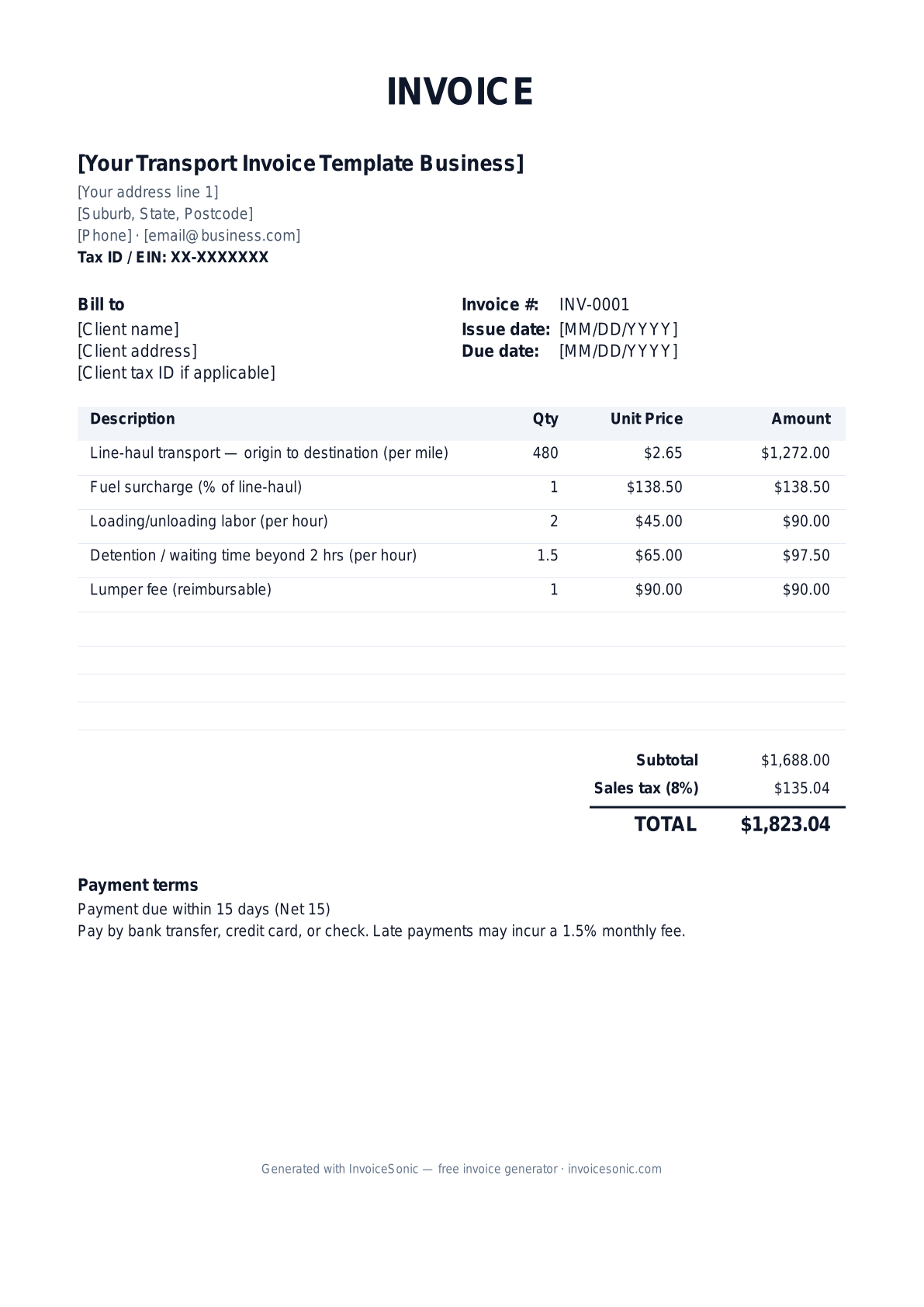
Download the transport invoice template
Or build it online in 60 seconds
Use InvoiceSonic's free generator — auto-calculate tax, prefill your details, and email the PDF straight to your client. No formatting needed.
Try the live generator →What's on the transport invoice template
| Description | Qty | Unit price | Amount |
|---|---|---|---|
| Line-haul transport — origin to destination (per mile) | 480 | $2.65 | $1,272.00 |
| Fuel surcharge (% of line-haul) | 1 | $138.50 | $138.50 |
| Loading/unloading labor (per hour) | 2 | $45.00 | $90.00 |
| Detention / waiting time beyond 2 hrs (per hour) | 1.5 | $65.00 | $97.50 |
| Lumper fee (reimbursable) | 1 | $90.00 | $90.00 |
| Subtotal | $1,688.00 | ||
| Sales tax (8%) | $135.04 | ||
| Total | $1,823.04 | ||
Example figures — every field is editable in the download.
Who uses this template
- ✓Owner-operator truckers
- ✓Courier and last-mile delivery companies
- ✓Freight brokers billing carriers
- ✓Passenger shuttle and charter operators
- ✓Equipment and machinery hauling services
What to include
- ✓Pickup and delivery addresses with dates
- ✓Total billed miles and per-mile rate
- ✓Fuel surcharge percentage
- ✓BOL or load/reference number
- ✓Detention and accessorial charges
- ✓USDOT/MC number and EIN
- ✓Net 30 payment terms and remit-to details
Available in 5 formats
Word (.docx)
Fully editable in Microsoft Word, Google Docs, Apple Pages and LibreOffice — best for quick text edits.
Excel (.xlsx)
Line totals, subtotal and tax calculate automatically — best if you want the math done for you.
A clean, print-ready, fixed layout — best for emailing a finished invoice to a client.
Google Docs / Sheets
Open in your browser, then File → Make a copy to edit and share with your team.
Invoicing tips for transport
- ✓ Reference the BOL or load number on every line so brokers can match your invoice to their rate confirmation fast.
- ✓ Bill fuel surcharge as its own line tied to a published index rather than burying it in your mileage rate.
- ✓ Log detention with start/stop times and attach signed delivery receipts to avoid disputed waiting charges.
- ✓ Pass lumper fees through at cost and keep the receipt — most shippers reimburse but require proof.
- ✓ Set Net 30 but offer a 2% quick-pay discount; brokers often factor and will take it.
Transport invoice FAQ
Do I charge sales tax on transport services?
Interstate freight hauling is generally exempt from US sales tax, but some states tax intrastate transport, local courier runs, or bundled handling. Check your state's department of revenue rules and add a sales tax line only where it applies.
What payment terms should a transport invoice use?
Net 30 is standard with freight brokers and shippers, though many carriers offer Net 15 or a 2% quick-pay discount. State your terms and late-fee policy clearly near the total.
Should I put my USDOT and MC numbers on the invoice?
Yes. Including your USDOT, MC, and EIN speeds up broker verification and is often required before they release payment. Add them to the header alongside your remit-to address.
Can I invoice per mile and per load on the same template?
Absolutely. Use separate line items — one for line-haul mileage and others for flat per-load, fuel surcharge, and accessorial fees — so the customer sees exactly how the total breaks down.
Related invoice templates
Prefer a specific format? Word invoice template · Excel invoice template · PDF invoice template · Google Docs invoice template · All invoice templates
A practical guide to trucking billing
Use the template as a starting layout, then replace its example information with the actual agreed work. The details below help you decide what to enter and what to check before sending.
Agree what this invoice covers
Match the invoice to the agreed load rate and separately authorised accessorial charges. State the units for waiting time, distance or extra stops. Use the rate confirmation or customer agreement to determine what is included in the base transport price.
Give the payer enough context
Include the load number, pickup and delivery dates, route and customer or broker reference. Check the legal billing name and delivery contact against the accepted work. Keep the agreed rate, proof of delivery and approval or supporting records for additional charges available to resolve questions. An invoice records the charge; it does not replace the underlying approval or supporting documents.
Worked trucking invoice example
The base load is charged once. Detention and the additional stop are separate, traceable items. These figures are illustrative, not freight-rate guidance; use the actual rate agreement and required evidence.
| Description | Quantity | Rate | Amount |
|---|---|---|---|
| Transport — load reference LD104 | 1 | 900.00 | 900.00 |
| Approved detention hours | 2 | 55.00 | 110.00 |
| Agreed additional stop | 1 | 65.00 | 65.00 |
| Example subtotal | 1,075.00 | ||
Avoid this billing mistake
Omitting the load number or proof of delivery can leave an otherwise correct invoice unmatched. Check the payer’s submission requirements before sending, including whether a portal or specific email address is required.
Follow up on the right record
If the broker reports missing paperwork, resend the relevant evidence against the original invoice number. Keep the payment record distinct from delivery completion: a delivered load does not mean the associated invoice is paid.
Before you send
- Match the line items and quantities to the accepted scope and approved changes.
- Check the invoice number, issue date, explicit due date and the load number, pickup and delivery dates, route and customer or broker reference.
- Apply only the tax treatment relevant to your business and location; check current local requirements if unsure.
- Keep earlier billing separate from actual payments. Verify the outstanding amount and payment instructions.
The free browser tool prepares the document. Saving customers, sending tracked invoices and managing reminders require an account and are subject to plan limits. Payment status needs accurate payment records; an invoice view alone does not confirm payment.