Free for US businesses · No signup to start · USD and sales tax
Towing Invoice: Bill Hook-Up, Mileage, Winching and Storage
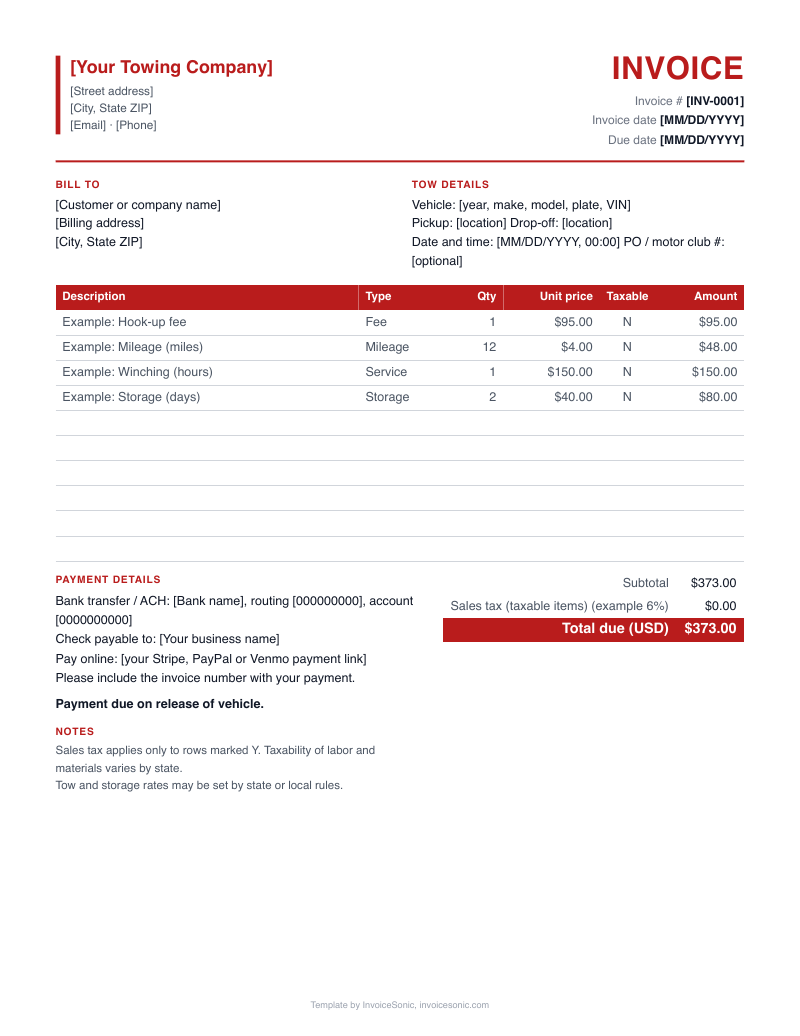
Towing invoice lines for a night recovery are already filled in below. Change the fees and miles, add the vehicle and both locations, and send it to the driver, insurer or motor club. Then read how to bill each charge and what to record on the call.
Create your invoice online
Download the towing invoice template
US Letter size, with labor, parts and taxable items already laid out. No email needed.
A file gets you one invoice. A free InvoiceSonic account saves your customers and line items for the next one.
What does a towing invoice look like? An example
Example only, with illustrative rates. A driver calls late at night after sliding a pickup into a ditch. The operator winches it back to the road, hooks up, and tows it 14 miles to a repair shop. The bill goes to the owner, who will pass it to their insurer.
| Description | Qty | Price | Amount |
|---|---|---|---|
| Hook-up fee, light-duty tow | 1 | $95.00 | $95.00 |
| Tow mileage, per loaded mile | 14 | $5.00 | $70.00 |
| After-hours fee, call at 11:40 pm | 1 | $60.00 | $60.00 |
| Winching, vehicle off road in ditch | 1 | $75.00 | $75.00 |
| Total due | $300.00 | ||
- Each fee has its own line. An insurer can then see what it is paying for, line by line.
- The pickup and drop addresses go on the invoice, along with the odometer or GPS miles behind the quantity of 14.
- No sales tax is shown in this example. Whether towing is taxed varies by state, so check yours.
Prices are illustrative. Use your own rates.
What should a towing invoice include?
A towing invoice should include your company details, the customer, the vehicle, the pickup and drop locations, the times of the call, each charge on its own line, and the total due. It should also carry a signature or a dispatch reference. It works as both your bill and your record of the tow.
- Company and truck
- Business name, address and phone, plus truck number and driver name. Add your license number if your state or customer requires it.
- Invoice and dispatch numbers
- Your invoice number, plus any call or job number from dispatch.
- Customer
- Name and phone of the driver or owner, and the party paying if that is someone else.
- Vehicle details
- Year, make, model, color, plate and VIN. Add the odometer if you can read it.
- Pickup and drop locations
- Use full addresses. For roadside calls, give the highway, mile marker and direction.
- Times
- Call received, arrival, hook-up and drop-off. These back up any wait or after-hours charge.
- Equipment used
- Flatbed, wheel lift, dollies or skates. Note if the job was light, medium or heavy duty.
- Vehicle condition
- Note existing damage, and whether the keys were left with the vehicle. Photos before loading are worth the minute they take.
- Charges and signature
- List every fee, add payment terms, and get a signature at release or drop-off.
How do you bill towing charges on an invoice?
Towing is usually billed as a hook-up fee plus a rate per mile, with extras for after-hours work, winching and storage. Put each on its own line. Rules on tow rates vary by state and city, especially for police and non-consent tows, so check locally before you set your rates.
- Hook-up fee
- A flat charge to attach and load the vehicle. Many operators set different fees for light, medium and heavy duty.
- Per-mile rate
- Quantity is the miles and the price is your rate. State whether you count loaded miles only or include the trip out.
- After-hours fee
- A flat add-on for nights, weekends or holidays. Show the time of the call on the line.
- Winching and recovery
- Bill by the job or by time. Write what you did, such as "winched from ditch, 30 minutes".
- Storage days
- Show days multiplied by the daily rate, with the in and out dates. Decide whether a day means a calendar day or 24 hours, then state it.
How do you create a towing invoice?
Create a towing invoice from the details you record on the call: vehicle, locations, times and miles. Add one line for each fee, then state who is paying. Finish it before the vehicle changes hands, while the driver or owner is there to sign.
- 1
Write down the vehicle details and take photos before you load.
- 2
Record the pickup location, the time of arrival and the starting miles.
- 3
At drop-off, record the address, the time and the ending miles.
- 4
Add the hook-up, mileage, after-hours, winching and any storage lines.
- 5
Add the claim, PO or motor club reference, and sales tax if it applies.
- 6
Get a signature, take payment or note who will be billed, and send the invoice.
Stop rebuilding this invoice for every job
Create a free account to save your customers and line items, email invoices from your phone or computer, and see what's been paid.
What towing invoice mistakes lose you money?
Tow operators lose money through missing references, unbilled storage days and charges they cannot prove. Motor clubs and insurers rarely pay for what the paperwork does not show. The fix is to record it on the call, not back at the yard.
- No PO from the motor club
- A club bill without its reference can sit unpaid. Get the number from dispatch before you roll.
- Missing over-mile charges
- If the club covers only part of the distance, bill the rest to the member. Collect it on the scene, because it is much harder to get later.
- Storage days not updated
- An invoice printed on day one is out of date by release. Reissue it with the final day count before the vehicle leaves.
- No times on the ticket
- An after-hours or waiting charge with no timestamps is easy to dispute. Write them down as they happen.
- Skipping the damage notes
- A claim for a scratch that was already there costs more than the tow earned. Photos and a signature close that off.
Towing invoice FAQ
How do I bill a motor club for a tow?
Put the club's PO or job number, the member's name and the covered service on the invoice, then submit it the way your contract says. Show covered charges separately from anything the member pays. Many clubs set their own rates, so bill the agreed amounts.
What is the difference between a towing invoice and a towing receipt?
An invoice is a bill that shows what is owed. A receipt confirms a payment was made. When a driver pays on the spot, one document can do both if it is marked paid, with the method and date.
Can I charge storage on a towed vehicle?
Many operators do, but rules on storage rates and notices vary by state and city. Check locally before you set a daily rate. On the invoice, show the in date, the out date and the rate per day.
Are there limits on what I can charge for a tow?
It depends on where you operate and the type of tow. State and local rules on tow rates vary, and a police or private property tow may be treated differently from a tow the owner called for. Check with your state and city before you publish rates.
How should I bill an insurance company for a tow?
Add the claim number, the policyholder's name and the vehicle details, then itemize every charge. Send photos with the invoice if you have them. If the owner pays first, give them a marked-paid copy to submit.
Do motor clubs or commercial accounts need a W-9?
Clients often request a W-9 before paying, so have one ready when you sign up. For payments made in 2026 the 1099-NEC threshold rose from $600 to $2,000, while 2025 payments still used $600. Confirm the details with a tax pro.