Free for US businesses · No signup to start · USD and sales tax
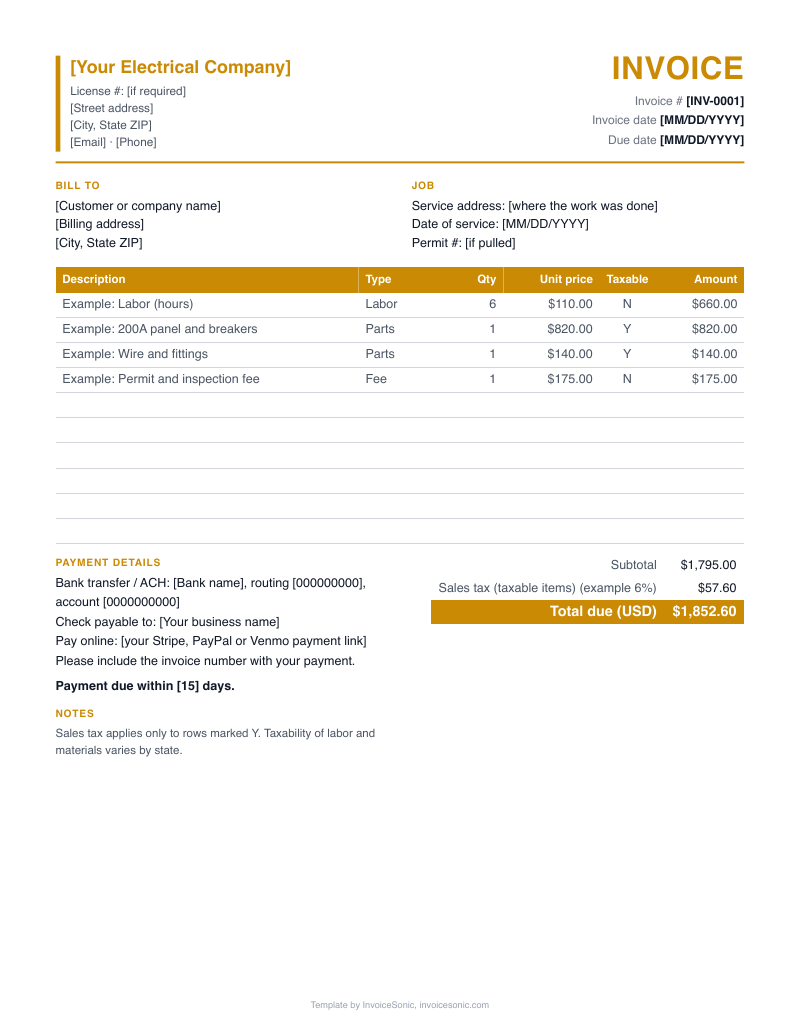
Electrician invoice template with a service panel example
Electrician invoice template fields should show the code-related costs that customers rarely see, not just labor and wire. This one comes filled with a sample 200-amp service panel upgrade, so you can edit it here now. Below is what goes in each field, and how to bill permits and inspections.
Create your invoice online
Download the electrical invoice template
US Letter size, with labor, parts and taxable items already laid out. No email needed.
A file gets you one invoice. A free InvoiceSonic account saves your customers and line items for the next one.
Example electrician invoice: 200-amp service panel upgrade
A homeowner replaces an old 100-amp panel with a 200-amp panel. The electrician pulls the permit, schedules the utility, swaps the panel and labels the circuits. All numbers are examples for illustration, not going rates.
| Description | Qty | Price | Amount |
|---|---|---|---|
| 200-amp main panel, breakers and materials | 1 | $980.00 | $980.00 |
| Electrician labor (hours) | 10 | $125.00 | $1,250.00 |
| Electrical permit fee, at cost | 1 | $150.00 | $150.00 |
| Inspection fee, at cost | 1 | $75.00 | $75.00 |
| Total due | $2,455.00 | ||
- The panel and its breakers sit on one material line. Put the brand and breaker count in the description if the customer wants detail.
- The permit and the inspection each get their own line marked at cost, separate from your labor and markup.
- No tax is applied to this sample. Whether labor or a service is subject to sales tax varies by state, so check your state and set your rate.
Prices are illustrative. Use your own rates.
What fields does an electrician invoice template need?
An electrician invoice template needs fields for your business, the customer, the job address, a work summary, labor, materials, permit and inspection fees, tax and terms. Separate rows for permits and inspections matter most, because those costs often get absorbed by accident.
- Company header
- Business name, address, phone and email, plus your license number if your state or customer requires it.
- Invoice number
- One unbroken sequence makes payments easy to match to jobs.
- Customer and job address
- Use two fields, since a general contractor pays from one address and the work happens at another.
- Job or PO reference
- Commercial and GC customers often will not pay without their PO or job number on the invoice.
- Scope of work
- Short and specific: replaced 100-amp panel with 200-amp panel, labeled 24 circuits.
- Labor rows
- Hours and rate, with apprentice and journeyman time on separate rows if you bill them differently.
- Material rows
- List big items by name, such as the panel, meter socket and EV charger. Group wire, connectors and staples.
- Permit and inspection rows
- One row each, labeled with the permit number when you have it.
- Terms and totals
- Subtotal, tax, deposit received, balance due, due date and how to pay.
How should an electrician bill permits, inspections and change work?
An electrician should bill permits and inspections as separate line items, not inside the labor rate. Customers can see the fee is a real cost, and you can spot when one was missed. Extra work found on site should go on its own line too.
- Permit fee at cost
- Copy the amount from the receipt and mark it at cost, with the permit number in the description. Keep the receipt with the job file.
- Permit handling time
- If you charge for the time spent applying and waiting, add a separate permit handling line instead of quietly raising the fee.
- Inspection fees
- Bill any fee as its own line. Say in your terms who pays for a return trip, or a failed inspection caused by site access or other trades turns into an argument.
- Rough-in and final stages
- On larger jobs, bill a deposit, then a progress invoice at rough-in, then the balance after final inspection. On GC work, retainage is common practice, so show it as a line.
- Change orders
- When you find aluminum wiring or a bad ground, get written approval and add a change order line. Reference the date the customer approved it.
How do you fill out an electrician invoice template?
Fill out an electrician invoice template by setting your header once, then entering scope, labor, materials and fees for each job. Work from your job folder, not from memory, so the permit receipt and supply house tickets are in front of you.
- 1
Enter your header and license number, if required, and save it as your master template.
- 2
Add the customer, job address and any PO or job number.
- 3
Write a one-line scope of work in plain language.
- 4
Enter labor hours, then replace the sample material lines using your supply house tickets.
- 5
Fill the permit and inspection rows from the receipts, or delete the rows if the job had none.
- 6
Subtract any deposit, check the balance due, set the due date, and export the invoice as a PDF.
Stop rebuilding this invoice for every job
Create a free account to save your customers and line items, email invoices from your phone or computer, and see what's been paid.
Which invoice mistakes cost electricians money?
The invoice mistakes that cost electricians money are absorbed permit fees, unbilled return trips and invoices that leave out a GC's paperwork. Each is small on its own, and each is fixed by a row or a line of terms in the template.
- Eating the permit
- If the template has no permit row, the fee disappears into your margin. Keep the row in the template and delete it only when it does not apply.
- Free return visits
- A second trip for an inspection that could not happen costs real time. Write your return-trip charge into the terms and bill it.
- Missing PO or lien waiver
- GCs commonly hold payment until paperwork matches, and may ask for a lien waiver with the invoice. Ask what they need when you start.
- Bundling extras into the scope
- Added outlets and fixtures vanish when they fall under the original scope line. Give each extra its own row with the date approved.
Electrical invoice FAQ
What does an electrician invoice look like?
It has your business details at the top, then customer and job information, a short scope of work, and rows for labor, materials and fees. Totals, payment terms and the balance due sit at the bottom. The example on this page shows the layout with a panel upgrade.
Do I have to put my license number on an electrician invoice?
If your state or customer requires it, add your license number. Rules differ, so check with your state's licensing board. Many electricians keep it in the header anyway, because it builds trust.
Should an electrician mark up permit fees?
That is your choice, as long as the invoice is honest about it. If you add anything, do not label the line at cost. A cleaner approach is to pass the fee through at cost and bill your time as a separate line.
Who pays when an electrical inspection has to be repeated?
That depends on your contract and on the reason it was repeated. Set this out in your terms before the job starts. Then bill it, or absorb it if the fault was yours, and note why.
Do I need a W-9 when invoicing a general contractor?
Often, yes. Clients commonly request a W-9 before paying. For payments made in 2026 the 1099-NEC reporting threshold rose from $600 to $2,000, while 2025 payments still used $600, so confirm how it applies to you with a tax pro.
Do electricians charge sales tax on invoices?
It varies. Whether labor or a service is subject to sales tax depends on the state, and materials may be handled differently. Check your state, then keep the tax row on your template set to the right rate.