Free for US businesses · No signup to start · USD and sales tax
Contractor Invoice: How to Write It, Bill Deposits and Get Paid
Contractor invoice writing comes down to billing the agreed work clearly, at the right moment, with nothing left for the client to query. Start with the sample below, change it to your job, and send it. Then use this guide for deposits, W-9 requests and payment terms.
Create your invoice online
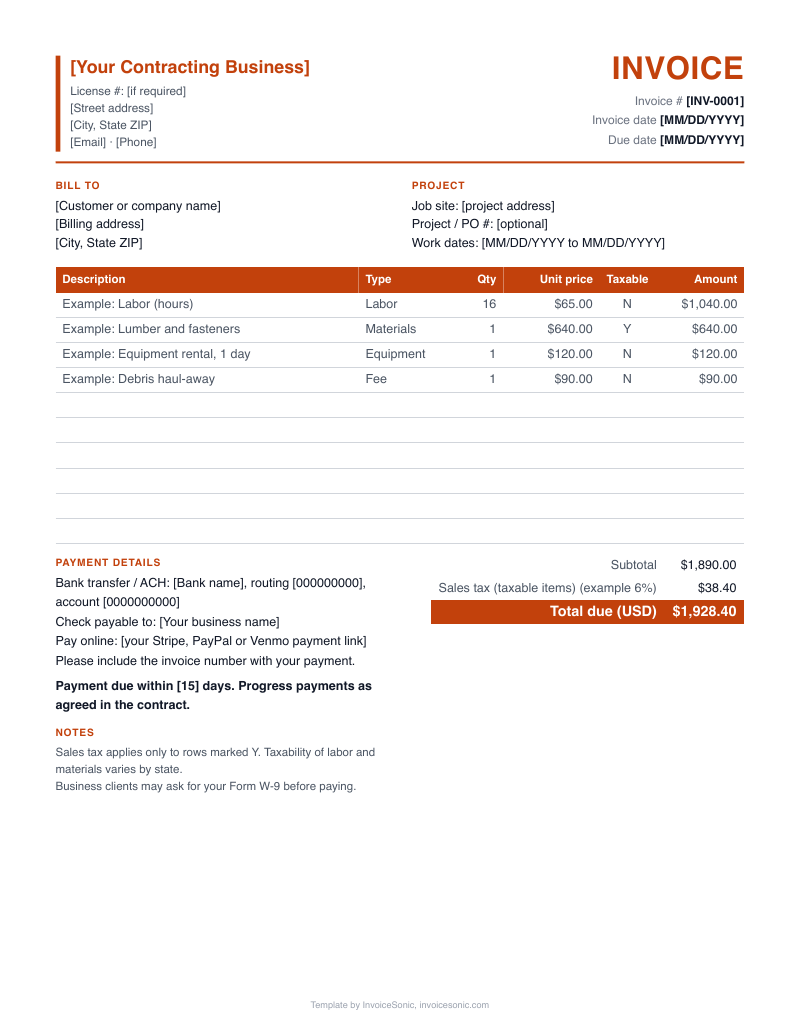
Download the contractor invoice template
US Letter size, with labor, parts and taxable items already laid out. No email needed.
A file gets you one invoice. A free InvoiceSonic account saves your customers and line items for the next one.
What does a contractor invoice look like for a subcontractor? (Example with illustrative prices)
An independent finish carpenter bills a general contractor for one week on an apartment project. Labor is by the day, trim supplied by the carpenter is on its own line, and a return visit for punch list items is billed separately. The figures are invented for layout only. Your rates will differ.
| Description | Qty | Price | Amount |
|---|---|---|---|
| Finish carpentry labor, Unit 3 (days) | 5 | $520.00 | $2,600.00 |
| Crown and base trim, supplied by contractor | 1 | $640.00 | $640.00 |
| Fasteners, adhesive and caulk | 1 | $85.00 | $85.00 |
| Punch list return visit | 1 | $150.00 | $150.00 |
| Total due | $3,475.00 | ||
- The carpenter puts the project name and the GC's PO in the description or reference field, because the GC's office may handle many jobs at once.
- Terms here are net 30, payable by ACH or check. A W-9 goes to the GC before the first invoice.
- This bill carries no sales tax. Rules on labor and materials vary by state, so check yours.
Prices are illustrative. Use your own rates.
What goes on a contractor invoice?
A contractor invoice needs to say who did the work, who owes the money, what was done, what it cost and when payment is due. Tie every charge to the agreement, so the person approving it has no reason to hold it.
- Payee name
- The name checks should be written to. Use the same name your client has on file.
- Who you are billing
- The person or company that signed the agreement, plus an accounts payable contact on commercial work.
- Job name and address
- On a multi-site account, the job reference tells the client which budget pays for it.
- Invoice number and due date
- An exact date reads better than a vague phrase. Write net 30 and the date it falls on.
- Work completed
- Plain task descriptions and the period covered. Write what the client would recognize, not your internal shorthand.
- Rate or agreed price
- Hours or days times your rate, or the fixed amount from the contract.
- Materials and reimbursables
- Items you bought for the job, plus any permit or dump fees the agreement lets you pass through.
- Payments already made
- Deposits and earlier invoices, so the amount due is not in doubt.
- How to pay
- ACH details, a check mailing address, or your Zelle, Venmo or Cash App handle. Add your license number if your state or customer requires it.
How should a contractor bill a job?
A contractor should bill in the way the contract sets out, in stages that keep payments ahead of your costs where you can. Small jobs can go on one invoice at the end. Larger jobs usually need a deposit and interim bills.
- Deposit up front
- Send a deposit invoice before you buy materials or book the crew. Check your state's rules on deposits before you set the amount.
- Payment at each stage
- Tie each bill to something the client can see, such as cabinets installed, rather than a date on the calendar.
- Weekly or monthly bills
- These suit open-ended or hourly work, because the unbilled balance never gets large.
- Final invoice at completion
- Send it the day the punch list closes, while the finished work is fresh in the client's mind.
How do you write a contractor invoice?
To write a contractor invoice, open the signed agreement, list what has been completed against it, subtract what has been paid and state the due date. It should take minutes if your job notes are current.
- 1
Pull the signed estimate or contract, plus any approved changes.
- 2
Add your business details and the client's billing details.
- 3
Write one line for each completed piece of work, with the price or hours and rate.
- 4
Add materials and reimbursable costs, then attach receipts if the contract calls for them.
- 5
Subtract the deposit and any earlier payments, then state the balance and due date.
- 6
Send it the day the work or stage finishes, and set a reminder for the due date.
Stop rebuilding this invoice for every job
Create a free account to save your customers and line items, email invoices from your phone or computer, and see what's been paid.
What billing mistakes cost contractors the most?
The biggest billing mistakes are waiting too long, skipping the deposit and leaving small extras unbilled. Each one means you are financing the client's job with your own cash.
- Billing weeks after the work
- Late invoices start the payment clock late, and memory of the details fades on both sides.
- Buying materials with no deposit
- A large supplier bill lands before any client money arrives. The deposit should at least cover the materials you must order.
- Forgetting the small costs
- Dump fees, permit runs and extra trips rarely get billed unless they are logged the day they happen.
- Holding up the first payment over paperwork
- A GC's office may not release money until it has your W-9 and insurance certificate. Send both before the first invoice, not after it is due.
Contractor invoice FAQ
What is the difference between a contract and an invoice?
A contract sets out what will be done and for how much, before the work starts. An invoice is the request for payment for work done, or a deposit due, under that agreement. A signed estimate often acts as the agreement on small jobs.
How much deposit should a contractor charge?
There is no single number. Many contractors size the deposit to cover materials and scheduling costs for the job. Check your state's rules first, then put the amount and when it is due in the agreement.
Do I need to send a W-9 with my invoice?
Clients often request a W-9 before paying, so it helps to have one ready. Send it once to each new client, ideally before the first invoice. Keep the name on it the same as the name on your invoices.
Will I get a 1099 for my contractor work?
For payments made in 2026, the 1099-NEC reporting threshold rose from $600 to $2,000 under the One Big Beautiful Bill Act. Payments made in 2025 still used $600. Confirm how this applies to you with a tax pro, and keep your own record of all income either way.
When should a contractor send an invoice?
Send it as soon as the work or stage is finished. Deposit invoices go out when the agreement is signed. On long jobs, follow the billing schedule in the contract.
What payment terms should a contractor use?
Homeowners are often billed due on receipt, while commercial clients often expect net 30. State the terms in your agreement and repeat them on every invoice. Any late fee should be in the agreement too, and it's worth checking your state's rules.