Free for US businesses · No signup to start · USD and sales tax
HVAC invoice for repairs, installs and maintenance plans
HVAC invoice details do more than request payment. They become the service record for that system. Use the builder here to create one now from a sample no-cool repair, then read how to bill diagnostics, service agreements and warranty work.
Create your invoice online
Download the hvac invoice template
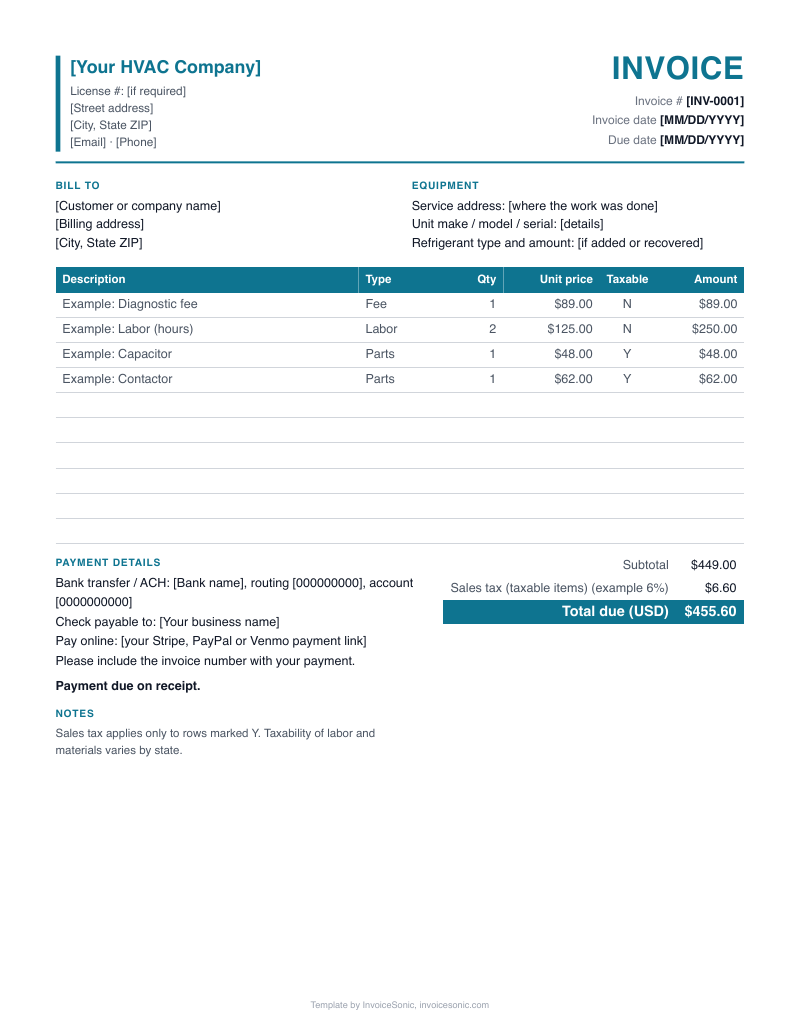
US Letter size, with labor, parts and taxable items already laid out. No email needed.
A file gets you one invoice. A free InvoiceSonic account saves your customers and line items for the next one.
Example HVAC invoice: no-cool repair in July
A homeowner's split system stopped cooling. The tech tests the unit, finds a failed capacitor and a low charge, replaces the part and adds two pounds of refrigerant. Prices in this example are invented for illustration. Use your own rates.
| Description | Qty | Price | Amount |
|---|---|---|---|
| Diagnostic fee, cooling system | 1 | $99.00 | $99.00 |
| Dual run capacitor, 45/5 MFD | 1 | $120.00 | $120.00 |
| Repair labor (hours) | 1.5 | $130.00 | $195.00 |
| R-410A refrigerant added (lb) | 2 | $85.00 | $170.00 |
| Total due | $584.00 | ||
- The notes field holds the system record: outdoor unit model and serial number, refrigerant type, and pounds added.
- Refrigerant is billed by the pound, so a low charge shows up as a number you can compare on the next visit.
- This sample has no tax on it. Whether labor or a service is taxed varies by state, so check your state before you set a rate.
Prices are illustrative. Use your own rates.
What should an HVAC invoice include?
An HVAC invoice should include your business and customer details, the equipment serviced, the diagnosis, parts and labor, refrigerant used, warranty terms and payment terms. Equipment details matter most, because the next tech and the manufacturer will both need them.
- Business and customer details
- Name, address, phone and email for both sides. Your license number goes here too if your state or customer requires it.
- Service address and unit location
- Include the location, such as attic air handler or rooftop unit 3. Commercial sites may have many units.
- Equipment make, model and serial
- List both indoor and outdoor units. Warranty lookups run on the serial number, so copy it from the data plate.
- Complaint and diagnosis
- Pair what the customer reported with what you found: no cooling, failed run capacitor.
- Parts
- Name each part, with quantity and price, and flag parts supplied under warranty.
- Labor
- Show flat price or hours times rate, and separate any after-hours premium.
- Refrigerant type and amount
- A useful record of what went in. Note the type and the pounds added or recovered.
- Warranty terms
- State your labor warranty period, and which parts fall under the manufacturer's coverage.
- Payment terms
- Show the due date and accepted methods: card, check, ACH, Zelle, Venmo or Cash App.
How do you bill HVAC diagnostic fees, service agreements and warranty work?
Bill HVAC work according to what triggered the visit. A diagnostic fee covers the finding, a maintenance agreement covers planned visits, and warranty work usually means parts at no charge with labor shown separately. Each one needs its own invoice wording.
- Diagnostic fee
- Show the fee on its own line even if the customer declines the repair. If you waive or credit it when they approve, add a matching negative line so the math is visible.
- Maintenance agreements
- Invoice the plan yearly or monthly, with the coverage dates on the line. On tune-up visits, issue a $0 invoice or a visit record listing what was checked and any member discount.
- Warranty repairs
- List the part at $0 with the manufacturer warranty named, then bill labor if your terms say labor is not covered. Customers often assume warranty means free, so explain it before the visit.
- System replacements
- Consider a deposit when you order equipment and the balance at startup. Put the new model and serial numbers, and the removal of old equipment, on the final invoice.
- Commercial accounts
- Reference the PO or work order number and bill on net 30 terms if agreed. Group visits by unit so the facility manager can trace costs.
How do you write an HVAC service invoice?
Write an HVAC service invoice by capturing the equipment first, then the diagnosis, then the charges. Doing it in that order at the unit, before you pack up, stops you from driving back for a serial number.
- 1
Photograph the data plates and enter make, model and serial number for each unit you touched.
- 2
Add the customer's complaint and your diagnosis in plain language.
- 3
Enter the diagnostic fee, then the parts, labor and any refrigerant by the pound.
- 4
Note whether each part is billable or covered by warranty.
- 5
Add your labor warranty terms and any repair the customer declined, such as a weak blower motor.
- 6
Have the customer review it, then collect payment or send it with a clear due date.
Stop rebuilding this invoice for every job
Create a free account to save your customers and line items, email invoices from your phone or computer, and see what's been paid.
What HVAC invoicing mistakes lose money?
The HVAC invoicing mistakes that lose the most money involve warranty confusion, unbilled refrigerant and silent declines. They look minor on one ticket, then repeat every summer.
- Labor given away on warranty calls
- If the invoice says only warranty repair, customers read it as no charge. Separate covered parts from billable labor in writing before you start.
- Refrigerant left off
- Top-offs are easy to forget at the end of a long day. Write down the pounds at the gauges, not back at the shop.
- Not recording declined repairs
- Note what you recommended and that the customer said no. If that part fails in August, the record protects you and gives you the follow-up job.
- Plans that lapse quietly
- An agreement with no renewal date on the invoice stops paying without anyone noticing. Print the end date on every plan invoice.
HVAC invoice FAQ
What is the difference between an HVAC service order and an invoice?
A service order records the work requested and often captures the customer's approval. An invoice asks for payment once the work is done. Many small shops combine both on one form, which works if it clearly shows the amount due.
Should you charge a diagnostic fee if the customer declines the repair?
Yes, if you told them about the fee when they booked. The fee pays for your time and your finding. Many shops credit it toward the repair if the customer approves the work.
Do you have to list refrigerant on an HVAC invoice?
List it as a useful record. The type and amount show the history of the system and support your charge. Check with your state or a qualified advisor on whether any rule applies to you.
How do you invoice an HVAC maintenance agreement?
Bill the agreement as one line with the coverage dates and the number of visits included. For monthly plans, send a recurring invoice at the same amount. Each visit can then get a record marked as covered by the plan.
How do you show warranty parts on an HVAC invoice?
List the part with its name and a $0 price, and note the manufacturer warranty. Add the failed unit's model and serial number. Bill diagnostic and labor on separate lines if your terms allow it.
Is sales tax charged on an HVAC invoice?
It depends on the state and sometimes on the type of work. Whether labor or a service is subject to sales tax varies by state, so check your state. Show any tax on its own line.