Free for US businesses · No signup to start · USD and sales tax
Landscaping invoice for monthly lawn care and one-off projects
Landscaping invoice setups differ between a weekly mowing route and a one-time patio planting job. Use the builder here to make one now from a sample month of lawn care with a mulch add-on. Below is how to bill recurring work, projects and seasonal contracts, and how to handle sales tax.
Create your invoice online
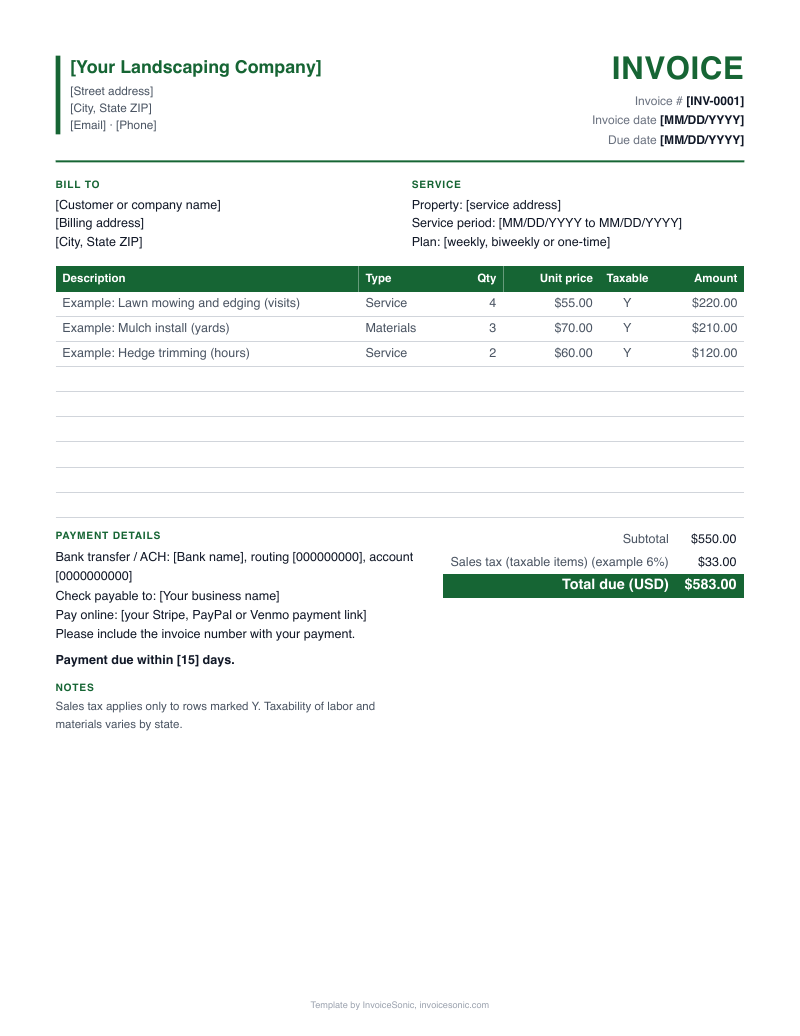
Download the landscaping invoice template
US Letter size, with labor, parts and taxable items already laid out. No email needed.
A file gets you one invoice. A free InvoiceSonic account saves your customers and line items for the next one.
Example landscaping invoice: June lawn care plus mulch
A Texas homeowner is on a weekly mowing plan and adds hedge trimming and a mulch refresh in June. All prices are examples, and the 8% tax is a placeholder rate, not a real rate for any location. Enter the rate for your job site.
| Description | Qty | Price | Amount |
|---|---|---|---|
| Weekly mowing, edging and blow-off (visits) | 4 | $55.00 | $220.00 |
| Hedge trimming, front beds | 1 | $60.00 | $60.00 |
| Mulch, delivered and spread (cubic yards) | 3 | $75.00 | $225.00 |
| Sales tax (example, 8%) | $40.40 | ||
| Total due | $545.40 | ||
- Listing visits as a quantity shows the customer that four mows happened this month, which heads off billing questions.
- Texas generally taxes landscaping and lawn care, so this example applies tax to all three lines. Confirm with the Comptroller's guidance or a tax pro.
- If the same customer also had fence or wall repair done, bill that separately. Texas treats it under different rules.
Prices are illustrative. Use your own rates.
What should a landscaping invoice include?
A landscaping invoice should include your business details, the customer, the property address, the service period, each service or material, tax and the due date. For recurring work, the service dates or visit count are the field that prevents the most disputes.
- Business details
- Name, address, phone and email. Include your license number if your state or customer requires it.
- Customer and billing contact
- On HOA and rental properties, the manager who pays is rarely the person living on site.
- Property address
- Crucial for property managers with many sites. Give each site its own invoice or section.
- Invoice number and date
- Use one running sequence across mowing and project work.
- Service period
- Write June 1 to June 30 and the visit dates for monthly plans.
- Services
- Mowing, edging, trimming, cleanup, aeration. Keep each on a separate line when priced separately.
- Plants and materials
- Mulch by the yard, sod by the pallet, plants by the count, with quantities.
- Sales tax
- A separate row, with taxable and non-taxable work split where your state treats them differently.
- Payment terms
- Due date, autopay option if you offer it, and accepted methods: check, card, ACH, Zelle, Venmo or Cash App.
How do you bill recurring lawn care versus one-off landscaping projects?
Bill recurring lawn care on a set schedule, usually monthly, and bill one-off landscaping projects in stages against an agreed scope. Mixing the two on one vague invoice is what causes confusion and slow payment.
- Monthly per-visit billing
- Count the visits and multiply by the price. The amount changes with the weather, so show the dates mowed.
- Flat monthly lawn care
- Same price each month, whatever the visit count. It evens out your cash flow. State how many visits it covers and how rained-out weeks are handled.
- Seasonal contracts
- Divide the contract price across agreed months, even for the slow ones, and print the contract dates and installment number on each invoice, such as 3 of 8. Say what happens if the customer cancels midway.
- One-off projects
- Take a deposit before you order plants or stone, then bill the balance at completion. Larger installs can have a progress invoice at a set milestone.
- Add-on work
- Extras like storm cleanup or mulch go on a separate line in the monthly bill, with the date the customer approved them.
How do you make an invoice for landscaping work?
Make a landscaping invoice by confirming the property and service period first, then listing services, materials and tax. Send recurring invoices on the same day each month so customers learn to expect them.
- 1
Add the bill-to contact and the property address.
- 2
Enter the service period, or the completion date for a project.
- 3
Add recurring services with the visit count, then list any approved extras.
- 4
List materials by unit, with deposits shown as a credit on project invoices.
- 5
Split taxable and non-taxable work if your state requires it, and apply the rate for the job location.
- 6
Set the due date and send it. Repeat on the same date next month.
Stop rebuilding this invoice for every job
Create a free account to save your customers and line items, email invoices from your phone or computer, and see what's been paid.
What landscaping invoicing mistakes lose money?
The landscaping invoicing mistakes that lose money are forgotten extras, tax applied to the wrong work, and unpaid winter months on a seasonal plan. Route work makes them easy to miss, because the amounts are small and the visits are many.
- Mixing landscaping and repair on one line
- In Texas, landscaping and lawn care are generally taxable, while labor to repair or remodel residential real property is not taxed, and nonresidential repair and remodel is taxable. Bill them separately, and check your own state's rules.
- Forgetting small extras
- The bag of mulch or the extra hedge trim adds up across a route. Have crews text or log extras the same day.
- No cancellation terms on seasonal plans
- A customer who leaves in September after the big spring work can owe you money with no written way to collect. Put the rule on the contract and the invoice.
- Buying materials on your own credit
- Large plant and stone orders can sit on your card for weeks. Collect the deposit before the order goes in.
Landscaping invoice FAQ
How do I write an invoice for lawn care?
Show your business and the customer, the property address and the service period. List each service with the number of visits and the price, then add tax if it applies. Finish with the due date and how to pay.
Should I bill lawn care monthly or after each visit?
Monthly billing usually means less paperwork for you and fewer payments for the customer. Per-visit billing can work for occasional or new customers. Many route businesses collect monthly and show each date serviced.
Do I charge sales tax on landscaping?
It depends on your state. Texas generally taxes landscaping and lawn care, but rules elsewhere differ, because whether a service is taxed varies by state. Check your state before you set a rate.
What happens to billing when rain cancels a mow?
Your terms decide that. On per-visit plans, a skipped visit simply is not billed. On flat monthly plans, say in advance whether the visit is rescheduled, credited or evened out over the season.
How do seasonal landscaping contracts work on an invoice?
Each invoice shows the same installment, the contract period and which payment it is. This keeps a slow month from looking like a charge for nothing. Add a line for any work outside the contract.
Do property managers need a W-9 from a landscaper?
Many clients ask for a W-9 before they pay a vendor. For 2026 payments, the 1099-NEC reporting threshold rose to $2,000 from the $600 that applied to 2025 payments. Confirm your own situation with a tax pro.