Free for US businesses · No signup to start · USD and sales tax
Roofing Invoice: Bill Squares, Tear-Off, Deposits and Insurance Claims
Roofing invoice lines need to show what went on the roof and what came off it. Build yours from the sample below, priced by the square, and send it when the job closes. The guide covers tear-off, decking, deposits and how to bill insurance claim and storm work.
Create your invoice online
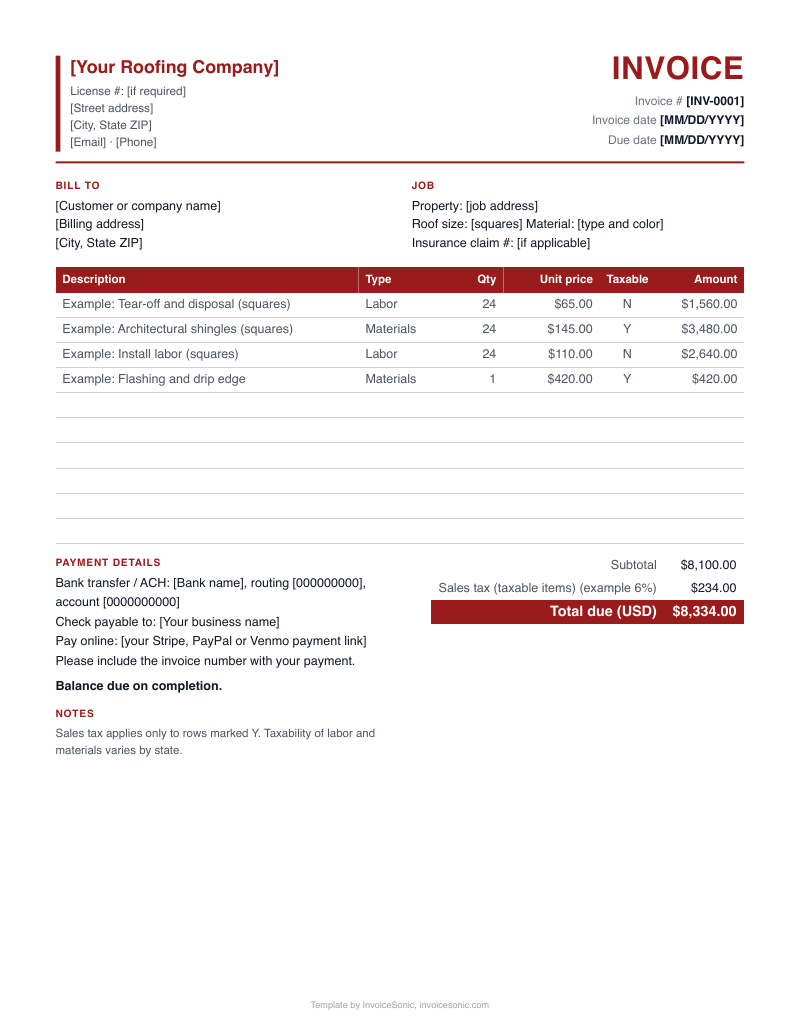
Download the roofing invoice template
US Letter size, with labor, parts and taxable items already laid out. No email needed.
A file gets you one invoice. A free InvoiceSonic account saves your customers and line items for the next one.
What does a roof replacement invoice look like? (Example with illustrative prices)
A roofer finishes a full replacement on a 24-square home. Tear-off is billed on the measured roof, shingles on 26 squares once a waste allowance is added, and six sheets of rotten decking found after tear-off are on their own line. The numbers are made up to show the layout. They are not typical prices.
| Description | Qty | Price | Amount |
|---|---|---|---|
| Tear-off and disposal, one layer of shingles (squares) | 24 | $70.00 | $1,680.00 |
| Architectural shingles installed, with underlayment (squares) | 26 | $360.00 | $9,360.00 |
| Replace rotted roof decking (sheets, approved on site) | 6 | $85.00 | $510.00 |
| Ridge vent, drip edge and pipe flashings | 1 | $640.00 | $640.00 |
| Total due | $12,190.00 | ||
- One square equals 100 square feet of roof. The invoice states the waste allowance, so nobody thinks the two square counts are an error.
- The decking line says approved on site, which is the first thing a homeowner or adjuster looks for on added work.
- The sample leaves sales tax out. Tax treatment of roofing labor and materials varies by state, so check yours. Any deposit received is taken off the balance due.
Prices are illustrative. Use your own rates.
What should a roofing invoice include?
A roofing invoice should include the property address, roof measurements in squares, tear-off, materials by product, labor, permits and disposal, any added work, the deposit received and the balance due. On an insurance job, add the claim number and carrier as well.
- Company and contact details
- Business name, address and phone. Add your license number if your state or customer requires it.
- Property and job
- The address, and a plain job label such as full replacement, leak repair or storm repair.
- Roof measurements
- Total squares, pitch, and number of layers removed. These support the rest of the numbers.
- Tear-off and disposal
- Layers removed, plus dumpster or haul-off costs.
- Materials
- Shingle brand, style and color, underlayment, ice and water shield, flashing and vents.
- Labor
- Priced into the square rate or listed apart. Add steep or high roof charges if they apply.
- Added work
- Decking, fascia or chimney flashing found after tear-off, with who approved it.
- Warranty note
- The workmanship term you offer, and the manufacturer's product warranty if one applies.
- Payment summary
- Deposit paid, insurance payments received, balance due and due date.
How do roofers bill a job?
Roofers usually bill by the square, take a deposit before materials are delivered, and collect the balance at completion. Repairs are often a flat price or hourly, and insurance claim jobs are paid in stages as the carrier releases funds.
- Per square
- The standard unit for a replacement. Add separate lines for extra layers, steep pitch and second-story access if they raise your cost.
- Deposit and balance
- A deposit invoice at contract signing, then a final invoice when the job and cleanup are done. Check your state's rules on deposits.
- Repairs and leak calls
- A flat price or a service call plus hourly labor. Describe where the leak was and what fixed it, so a repeat call can be traced.
- Insurance claim jobs
- Bill the scope the carrier approved, line by line. Many policies pay an initial amount, then release held-back depreciation once the insurer sees the final invoice.
- Storm and emergency work
- Bill emergency tarping as its own dated invoice. It keeps the urgent work separate from the full replacement claim.
How do you write a roofing invoice?
To write a roofing invoice, start from the signed contract or the insurer's scope, confirm the final measurements, then list tear-off, materials, labor and added work. Close it with payments received and the balance due.
- 1
Confirm the final squares, layers and pitch from your measurement report or the crew's notes.
- 2
List tear-off and disposal, then materials by product.
- 3
Add labor and any charges for pitch, height or access.
- 4
Enter added work with photos on file and the approval noted.
- 5
On claim jobs, add the claim number, carrier and adjuster's contact.
- 6
Subtract the deposit and any insurance money received, then send it after final cleanup and a magnet sweep.
Stop rebuilding this invoice for every job
Create a free account to save your customers and line items, email invoices from your phone or computer, and see what's been paid.
Which roofing invoice mistakes lose money?
Roofers lose the most on decking found mid-job, supplement items left off the claim, and held-back insurance money nobody chases. Each is tied to paperwork at the end of the job, not the roof itself.
- Replacing decking without a sign-off
- Get a text or signature before you lay new sheets, with a photo of the damage, or the line becomes an argument.
- Not filing a supplement
- If you find work the adjuster's scope missed, document it before covering it up. Once the shingles are on, the proof is gone.
- Waiting on a held-back check
- Send the final invoice as soon as the job closes, because the homeowner may need it to request the rest of their claim money.
- Blurring the deductible
- Show the homeowner's deductible as what they owe you. Never hide or discount it on the invoice without checking your state's rules first.
Roofing invoice FAQ
How do I invoice a roofing job paid by insurance?
Match your invoice to the adjuster's scope, and include the claim number and carrier. Show any approved supplements and the homeowner's deductible separately. The insurer or homeowner may ask for the final invoice before releasing the remaining funds.
What is a square in roofing?
A square is 100 square feet of roof surface. Roofers price and order materials by the square, so a 24-square roof covers 2,400 square feet. Invoices often show extra squares to account for waste from cuts.
When should a roofer send the invoice?
Send a deposit invoice at signing and the final invoice when the job, cleanup and walk-through are done. For insurance jobs, send the final invoice promptly, since it can trigger the next payment. Repairs can be invoiced on the day.
Who is the check made out to on an insurance job?
Insurance checks are often made out to the homeowner, and may also name the mortgage company. Expect some delay while the mortgage company processes its part. Note each payment on your invoice as it arrives.
Should a roofing invoice list materials separately from labor?
Listing them separately helps on insurance jobs and with homeowners who want to see what they paid for. It may also matter for sales tax, since treatment varies by state. If your contract sets one price per square, you can still note the materials used.
Can I bill for storm tarping separately?
Yes, and it is usually cleaner to do so. Send a dated invoice for the emergency work with photos and materials used. The homeowner can then submit it with the claim, and it stays apart from the replacement scope.