Free for US businesses · No signup to start · USD and sales tax
Construction Invoice: Billing Methods, Pay Applications and Lien Waivers
Construction invoice work starts with one question: how does your contract say you get paid? Build yours from the cost-plus sample below, or change it to fit your job. Then use the guide to match the invoice to your billing method, pay application and lien waiver paperwork.
Create your invoice online
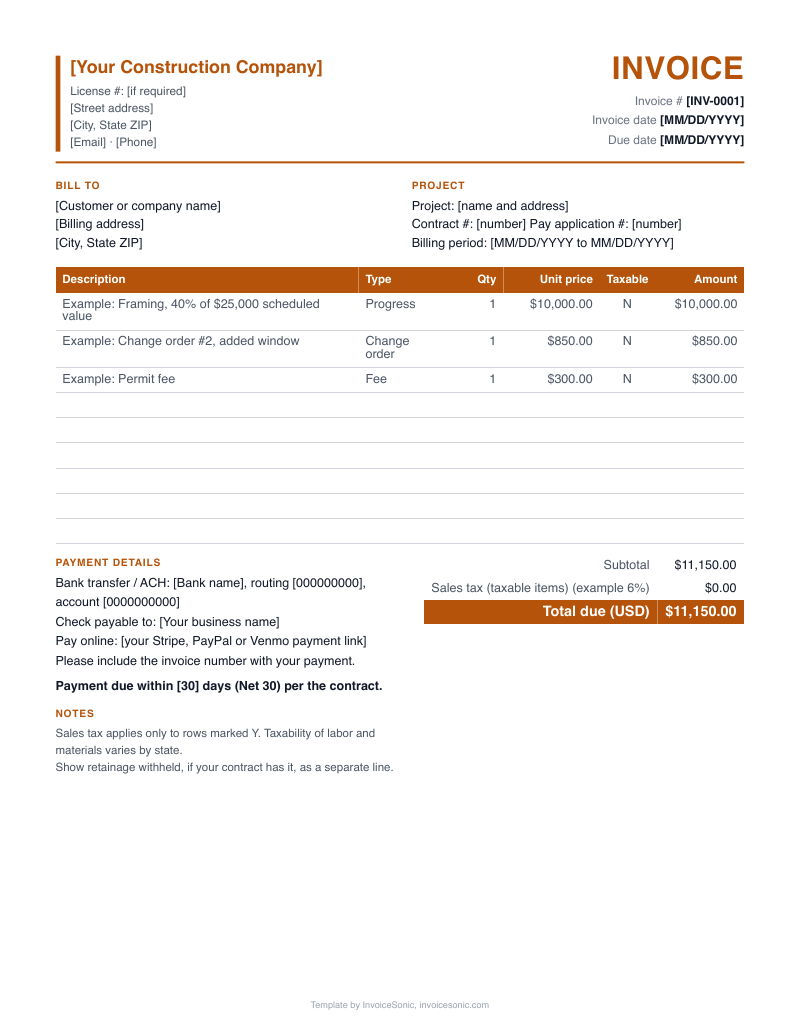
Download the construction invoice template
US Letter size, with labor, parts and taxable items already laid out. No email needed.
A file gets you one invoice. A free InvoiceSonic account saves your customers and line items for the next one.
What does a cost-plus construction invoice look like? (Example with illustrative prices)
A remodeler bills the first month of a garage conversion under a cost-plus contract. Labor, materials and the electrical sub are passed through at cost, then the agreed fee is added on its own line. The 15% fee and every other figure here is an invented example, not a suggested rate.
| Description | Qty | Price | Amount |
|---|---|---|---|
| Framing and drywall crew labor at cost (hours) | 64 | $68.00 | $4,352.00 |
| Lumber, drywall and fasteners at cost, per receipts | 1 | $3,180.00 | $3,180.00 |
| Subcontractor: electrical rough-in, per sub invoice | 1 | $2,400.00 | $2,400.00 |
| Contractor fee: 15% of the costs above | 1 | $1,489.80 | $1,489.80 |
| Total due | $11,421.80 | ||
- The fee line equals 15% of the three cost lines, so the client can check the sum in seconds.
- On cost-plus work, keep every receipt and sub invoice, because the contract may let the owner review them.
- No sales tax appears here. In Texas, for example, labor to repair or remodel residential real property is not taxed, while nonresidential repair and remodel is taxable. Other states differ, so check yours.
Prices are illustrative. Use your own rates.
What is a construction invoice and what must it show?
A construction invoice is a contractor's bill for work on a building project, covering labor, materials, subcontractors and any changes for a set period or stage. Unlike a one-off service bill, it usually has to tie back to a contract and to earlier payments on the same job.
- Contractor and client details
- Both legal names and addresses. Add your license number if your state or customer requires it.
- Project identity
- Project name and site address, which can matter later if a payment dispute reaches the property records.
- Contract reference
- The contract date or number, and the billing method it uses.
- Period or stage billed
- The dates covered or the milestone reached.
- Labor and equipment
- Crew hours, equipment rental and rates where the contract calls for them.
- Materials and subcontractors
- Supplier and sub costs, with backup attached if the contract requires it.
- Change work
- Each approved change, listed apart from the base contract.
- Payment position
- Previous payments, any retainage held and the amount due now, with the due date and accepted payment methods.
What are the main construction billing methods?
The five main construction billing methods are lump sum, cost-plus, time and materials, unit price and progress billing. The contract picks the method, and the method decides what the invoice shows and how much backup the client can expect.
- Lump sum
- One fixed price for a defined scope, usually billed in stages. The client sees amounts, not your costs, and overruns are yours unless a change order covers them.
- Cost-plus
- Actual costs plus an agreed fee or markup. Invoices need full cost backup, so bookkeeping matters more than on any other method.
- Time and materials
- Hours at set rates plus materials, common for repairs and unclear scopes. Daily time tickets signed by the client head off most disputes.
- Unit price
- A price per unit such as a cubic yard of concrete or a linear foot of pipe. Invoices show measured quantities, so agree how they will be measured.
- Progress billing
- Bills by percent complete against a schedule of values, typical on larger jobs. It can sit on top of a lump sum contract, and it keeps cash moving through a long build.
How do you write a construction invoice?
Write a construction invoice by confirming the billing method and cutoff date, gathering costs and quantities for the period, then stating the net amount due after earlier payments. Send it with whatever backup the contract asks for.
- 1
Check the contract for the billing method, cutoff date and required backup.
- 2
Collect time tickets, supplier bills and sub invoices for the period.
- 3
List the work billed, with base contract and approved changes kept apart.
- 4
Take off previous payments and any retainage the contract allows.
- 5
Attach the pay application pages or lien waivers the client requires.
- 6
Send it to the right person before the cutoff, and log the date for follow-up.
Stop rebuilding this invoice for every job
Create a free account to save your customers and line items, email invoices from your phone or computer, and see what's been paid.
What construction billing mistakes hurt cash flow?
The mistakes that hurt most are missed cutoffs, incomplete pay packages and costs that never reach an invoice. On a monthly draw cycle, one miss can push your money back a full month.
- Missing the billing cutoff
- Many owners and GCs review draws on a fixed date. A late invoice can roll into the next cycle.
- Sending a pay app without its waivers
- If the client asks for lien waivers with each draw and yours are missing, expect the check to wait.
- Starting change work before sign-off
- On lump sum jobs, extra work without a signed change order often turns into free work.
- Letting your lien deadlines lapse
- Lien rights and notice deadlines vary by state. Check yours at the start of the job, not when a payment is already late.
Construction invoice FAQ
What is a pay application in construction?
A pay application is a formal request for a progress payment, usually with a summary page and a line-by-line continuation sheet. Many projects use AIA-style forms, known as G702 and G703, or a version of them. It is common practice on larger jobs, and your contract decides whether you need one.
What is a lien waiver and when do I send one?
A lien waiver is a document where a contractor or supplier gives up lien rights for a stated payment. Owners, GCs and lenders commonly ask for one with each payment. Waivers can be conditional on payment or unconditional, so read what you sign and get advice if unsure.
Is a construction invoice different from a pay application?
An invoice is a bill stating an amount due. A pay application gives more detail, showing progress against the whole contract with the schedule of values, retainage and change orders. On some jobs you send both.
Do construction invoices include sales tax?
It depends on the state and the type of work, and on how the contract treats materials. Whether labor is taxed varies by state, so don't assume one rule applies everywhere. Check your state's revenue department or ask a tax pro.
How often should I invoice on a construction job?
Follow the contract. Monthly billing is common on long jobs, while short jobs are often billed at milestones or on completion. If the contract is silent, agree a schedule in writing before you start.
What should I do if a construction invoice goes unpaid?
Call the person who approves payment and confirm they have everything they need. Follow up in writing, then check your contract and your state's lien deadlines. Talk to a construction attorney before the deadline passes if the amount justifies it.