Free for US businesses · No signup to start · USD and sales tax
House Cleaning Invoice: Bill Homeowners and Get Paid Sooner
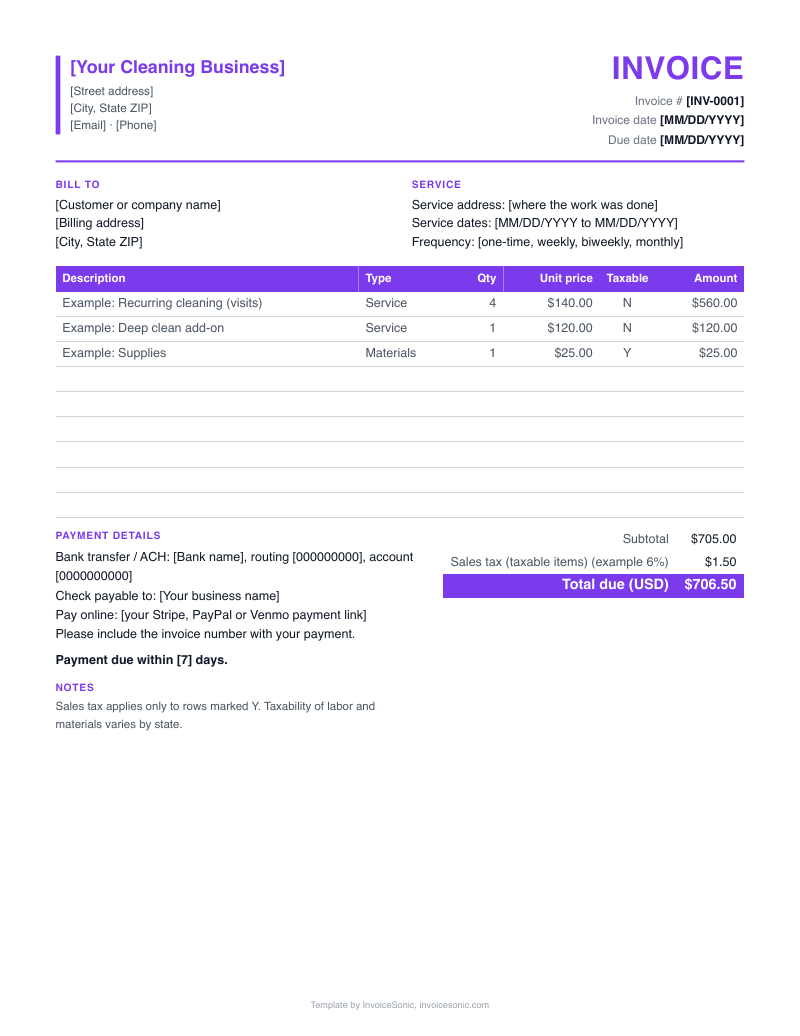
House cleaning invoice lines are already filled in below for a typical biweekly client. Swap in your own rates and add-ons, then send it to the homeowner the day you finish. Below that, see how to bill regular visits, deep cleans, tips and late cancellations.
Create your invoice online
Download the house cleaning invoice template
US Letter size, with labor, parts and taxable items already laid out. No email needed.
A file gets you one invoice. A free InvoiceSonic account saves your customers and line items for the next one.
What does a house cleaning invoice look like? An example
Example only, and the prices are made up for illustration. A self-employed cleaner has a biweekly client with a three-bedroom home. She bills once a month for two visits, one round of deep-clean extras, an oven and fridge clean, and a visit the client canceled that morning.
| Description | Qty | Price | Amount |
|---|---|---|---|
| Biweekly house cleaning, 3 bed 2 bath, per visit | 2 | $145.00 | $290.00 |
| Deep clean add-on: baseboards and inside cabinets | 1 | $85.00 | $85.00 |
| Inside oven and fridge | 1 | $45.00 | $45.00 |
| Late cancellation fee, Nov 14 visit | 1 | $50.00 | $50.00 |
| Total due | $470.00 | ||
- Each visit date goes in the notes, such as Nov 7 and Nov 21, so the homeowner can check them against their calendar.
- The cancellation fee has its own line with the date. It looks fair because the client can see what it refers to.
- No sales tax appears in this example. Whether house cleaning is taxed depends on where you work, so check your state.
Prices are illustrative. Use your own rates.
What should a house cleaning invoice include?
A house cleaning invoice should include your name and contact details, the client's name and home address, the visit dates, what was cleaned, the price of each service, and how to pay. Keep it short enough to read on a phone. Most homeowners will open it there.
- Your name or business name
- Add a phone number the client already recognizes, so the message is not mistaken for spam.
- Client name and address
- Use the home you cleaned. If a landlord or relative pays, add their name too.
- Invoice number
- A simple running number is enough, and it gives you a reference for the payment memo.
- Visit dates
- List every visit covered, especially on a monthly bill.
- Service type
- Say standard, deep clean or move-out clean. Home size is useful too, such as 3 bed 2 bath.
- Add-ons
- Oven, fridge, interior windows and laundry each get a line, so they read as extras and not a price rise.
- Fees
- Show cancellation or lockout fees separately, with the date they apply to.
- Due date
- Write a date, or "due on the day of service" if that is your policy.
- How to pay
- Give your Zelle phone or email, Venmo handle, Cash App tag, or who to make a check out to.
How do house cleaners charge and bill clients?
House cleaners usually charge a flat price per visit, based on the size of the home and how often they come. An hourly rate also works for first visits and messy jobs. Whichever you use, the invoice should show the unit you sold.
- Per visit, flat
- The simplest line for homeowners. Quantity is the number of visits and the rate is your price per clean.
- Weekly or biweekly
- Regular clients can pay after each visit or on one monthly bill. On biweekly schedules, some months have three visits, so check the count before you send it.
- Deep clean
- Price this as its own line. Many cleaners charge it on the first visit, then drop to the regular rate once the home is at a standard they can maintain.
- Hourly by labor hours
- Two cleaners for two hours is four labor hours, not two. Write "2 cleaners x 2 hours" so the client sees why the quantity is 4.
- Move-out clean
- Bill it as a one-time flat job, and name the address and date. Tenants may need a clear record for a landlord.
How do you write a house cleaning invoice?
Write a house cleaning invoice right after the visit, while the details are fresh. List the date, the type of clean and any extras, then add how to pay. Sending it the same day is the easiest way to get paid the same day.
- 1
Add your name, contact details and the next invoice number.
- 2
Enter the client's name, the home address and the visit date or dates.
- 3
Add one line for the clean, then one line for each extra.
- 4
Add any cancellation or lockout fee with its date.
- 5
Write your Zelle, Venmo, Cash App or check details and the due date.
- 6
Text or email it from your phone before you leave the street.
Stop rebuilding this invoice for every job
Create a free account to save your customers and line items, email invoices from your phone or computer, and see what's been paid.
What house cleaning billing mistakes lose you money?
House cleaners mostly lose money on unbilled extra time and on visits they could not do. Fees only hold up if the client agreed to them first, so set your rules before the first clean.
- Charging a fee you never mentioned
- A surprise cancellation fee often turns into a lost client. Put the window, such as 24 hours, in your welcome text or service agreement.
- Free deep cleans
- A home that took five hours at a two-hour price is a loss. Quote the first visit as a deep clean, or add the extra time to the bill with the client's OK.
- Payment memos with no reference
- A Zelle payment with no note is hard to match when you have many clients. Ask clients to put the invoice number in the memo.
- Forgetting lockouts
- If you drove there and could not get in, you still lost the slot. Decide on a lockout fee, tell clients about it, and bill it.
- Rounding down time for add-ons
- Fridges, ovens and laundry add up over a month. If a client asks for one on the day, add the line then.
House cleaning invoice FAQ
Should tips go on a house cleaning invoice?
Leave tips off the service lines, because a tip is the client's choice. If you like, add a short note such as "tips are welcome and never expected" near the payment details. If a client pays extra, record it as a tip in your own books, and ask a tax pro how to report it.
How much should I charge to clean a 2,000 square foot house?
There is no single right price, because condition, pets, bathrooms and how often you visit all change the time needed. Time a few homes of that size, multiply by the hourly amount you need to earn, and add your supplies and travel. Then quote a flat price per visit.
Can I charge a cancellation fee as a house cleaner?
Many cleaners do, and it works best when the client agreed in advance. Tell them the notice period and the amount before the first visit, then show the fee on its own line with the date. Many cleaners waive the first one to keep goodwill.
Can clients pay a house cleaner by Zelle or Venmo?
Yes, and many homeowners prefer it. Print your Zelle phone or email or your Venmo handle on the invoice, and ask for the invoice number in the memo. That gives you a clean record to match against your bank statement.
Should I invoice after every visit or once a month?
After each visit suits new clients and one-off jobs, because you get paid sooner. A monthly bill suits long-term clients who prefer one payment. Ask each client which they want, and note it on their file.
What is the 80/20 rule in house cleaning?
It usually means that a small share of tasks, such as kitchens, bathrooms and floors, makes most of the difference a client notices. For billing, it is a good guide to what belongs in a standard visit. The rest can be priced as add-ons.