Free for US businesses · No signup to start · USD and sales tax
Plumbing invoice for US service calls and emergency work
Plumbing invoice wording decides whether a homeowner pays at the door or calls to argue about the bill. Use the builder on this page to write a plumber invoice now, starting from a sample after-hours leak repair. Below is how to bill the service call, the emergency rate and the labor so each charge holds up.
Create your invoice online
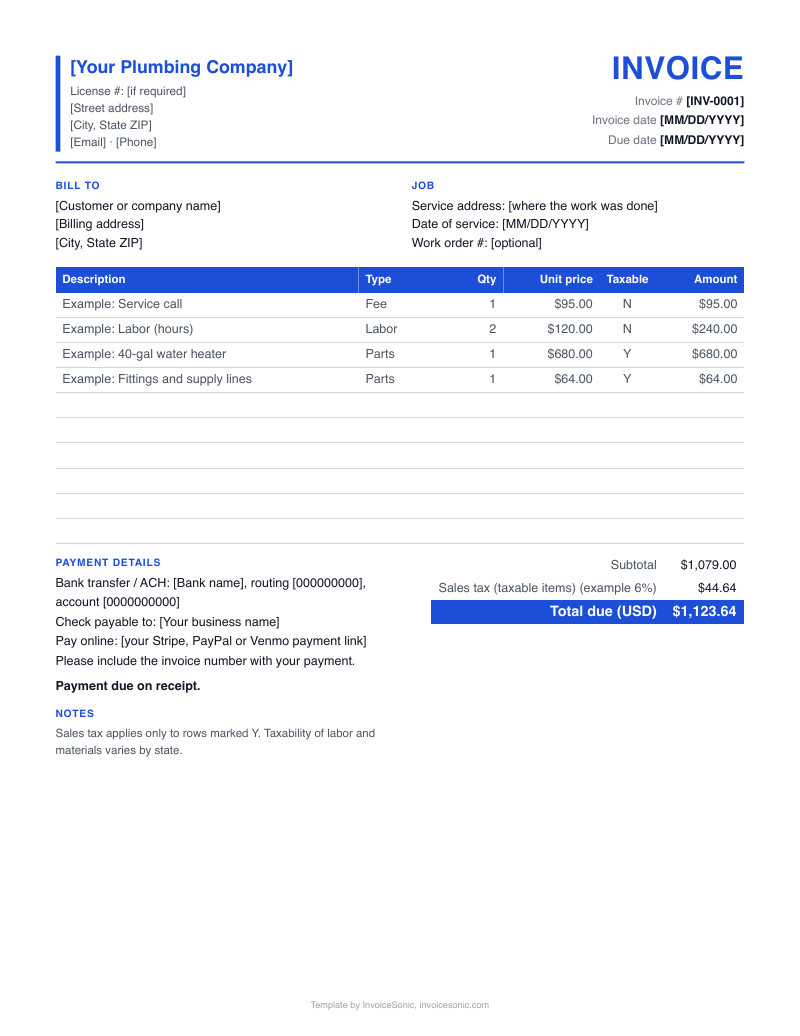
Download the plumbing invoice template
US Letter size, with labor, parts and taxable items already laid out. No email needed.
A file gets you one invoice. A free InvoiceSonic account saves your customers and line items for the next one.
Example plumbing invoice: Saturday night leak repair
A homeowner calls at 9:40 p.m. on a Saturday about water under the kitchen sink. The plumber arrives at 10:30, finds a split PEX line and two seized shutoffs, and finishes just after midnight. All prices here are made-up examples, not market rates. Swap in your own.
| Description | Qty | Price | Amount |
|---|---|---|---|
| After-hours emergency service call | 1 | $195.00 | $195.00 |
| Labor to locate and repair leak (hours) | 2 | $135.00 | $270.00 |
| PEX pipe, fittings and clamps | 1 | $64.00 | $64.00 |
| Quarter-turn angle stop valve | 2 | $18.00 | $36.00 |
| Total due | $565.00 | ||
- The after-hours charge sits on its own line, so the customer sees exactly what the late call cost.
- Labor shows hours times a rate. Add the arrival and finish times to the job notes to back up the hours.
- Sales tax is set to 0 in this example. Whether labor or parts are taxed varies by state, so check your state and set your own rate.
Prices are illustrative. Use your own rates.
What should a plumbing invoice include?
A plumbing invoice should show who did the work, where it happened, what was wrong, what was done, and what each part of the job cost. Clear labor and parts lines, plus the payment terms, answer most questions before the customer asks them.
- Your business details
- Name, address, phone, email and EIN if customers ask for it. Add your license number if your state or customer requires it.
- Who is paying
- The bill-to name can differ from the job site. A tenant may call you while the owner or property manager pays.
- Job site address
- List the service address, and the unit number for rentals and apartments.
- Invoice number and dates
- Use one running number, plus the invoice date and the service date.
- Problem found
- One line in plain words, such as split PEX line under kitchen sink.
- Work performed
- Say what you replaced or repaired, so a later callback is easy to judge.
- Labor
- Show hours and rate for T&M, or one job price for flat-rate work.
- Parts and materials
- Name each part that matters, with quantity and price. Group small fittings on one line.
- Payment terms
- State the due date and how you accept money: check, card, ACH, Zelle, Venmo or Cash App.
How do plumbers charge for service calls, emergencies and repairs?
Plumbers usually charge in one of two ways: flat rate by the job, or time and materials. A service call fee or an after-hours rate can sit on top of either one. The method matters less than telling the customer before you start.
- Service call fee
- A set charge for showing up and diagnosing. Say on the invoice whether it was credited toward the repair, so a customer who approved the work does not think they paid twice.
- Flat-rate pricing
- One price per task, such as replacing a toilet fill valve. The customer knows the cost up front and you carry the risk if it runs long. Suits repeat jobs you can time well.
- Time and materials
- Hours times your rate, plus parts. Suits hidden leaks and old pipe, where nobody knows the scope. Keep start and stop times so the hours can be defended.
- Emergency and after-hours rates
- Use a separate line or a higher hourly rate, not both unless you said so on the phone. Define after-hours in your terms, such as after 6 p.m., weekends and holidays.
- Minimum charge
- If you bill a one-hour minimum, write it on the labor line. A 20-minute fix then explains itself.
How do you write a plumbing invoice for a service call?
Write the plumbing invoice on site, before you leave, while the times and parts are fresh. Most of the work is recording what you did and which pricing method applies.
- 1
Add the bill-to name and the service address, and confirm who is paying if the caller is a tenant.
- 2
Enter the service call fee or after-hours charge on its own line.
- 3
Describe the problem found and the work done in one or two plain sentences.
- 4
Add labor as a flat job price, or as hours times your rate with start and finish times.
- 5
List parts used, including anything taken off the truck that is easy to forget.
- 6
Set the due date, show the customer the total, and take payment or send the invoice before you drive away.
Stop rebuilding this invoice for every job
Create a free account to save your customers and line items, email invoices from your phone or computer, and see what's been paid.
What plumbing billing mistakes cost you money?
The costliest plumbing billing mistakes are forgetting truck stock, leaving the after-hours rate unexplained, and invoicing days after the job. Each one lowers what you collect or gives the customer a reason to delay.
- Forgetting truck stock
- Small valves, supply lines and fittings pulled from the van rarely get written down. Log them as you use them, or you pay for them yourself.
- Quoting a rate only by phone
- If the emergency rate first appears on the invoice, expect a dispute. Mention it when booking and repeat it in writing before work starts.
- Billing the tenant by mistake
- Ask who pays before you dispatch. Sending a bill to the wrong party can add weeks, and the owner may not have approved the work.
- Vague drain notes
- Write what you cleared and what you found, such as roots at 40 feet, camera inspection recommended. It protects you when the line backs up next month.
- Waiting until Friday
- A homeowner is most willing to pay while the leak is freshly fixed. A week later, the invoice competes with every other bill.
Plumbing invoice FAQ
How do you write an invoice for services rendered?
List your business, the customer, the date of service and a short description of the work. Then add the labor and parts charges, any tax, and the payment due date. For plumbing, add the job address and the problem you found.
How do plumbers charge for plumbing services?
Most use flat-rate pricing, time and materials, or a mix of both. A service call fee and an after-hours rate are common add-ons. Pick one method per job and show it clearly on the invoice.
How much does a plumber charge for a quote?
It depends on the business. Some quote at no charge, while others charge a service call fee and credit it if the customer approves the repair. If you charge, tell the customer when they book.
Can a plumber charge more for nights and weekends?
Yes, plumbers commonly charge a higher rate outside normal hours. Tell the customer before you roll the truck, and show the charge on its own line. That keeps the conversation at the door short.
Do plumbers charge sales tax on an invoice?
It depends on where the job is. Whether labor or a service is subject to sales tax varies by state, and parts may be treated differently. Check your state and show any tax on a separate line.
When is a plumbing invoice due?
That is up to your terms. Residential service work is often collected when the job finishes, while property managers and commercial accounts may ask for net 15 or net 30. Write the exact due date on the invoice instead of leaving it open.