Free for US businesses · No signup to start · USD and sales tax
Auto Repair Invoice: Itemize Parts, Labor and Vehicle Details
Auto repair invoice lines for an alternator job are already filled in below. Replace them with your own repair order, add the vehicle details and give it to the customer at pickup. The guide also works as an auto repair invoice template, covering how to bill labor hours, shop supplies and strict state rules.
Create your invoice online
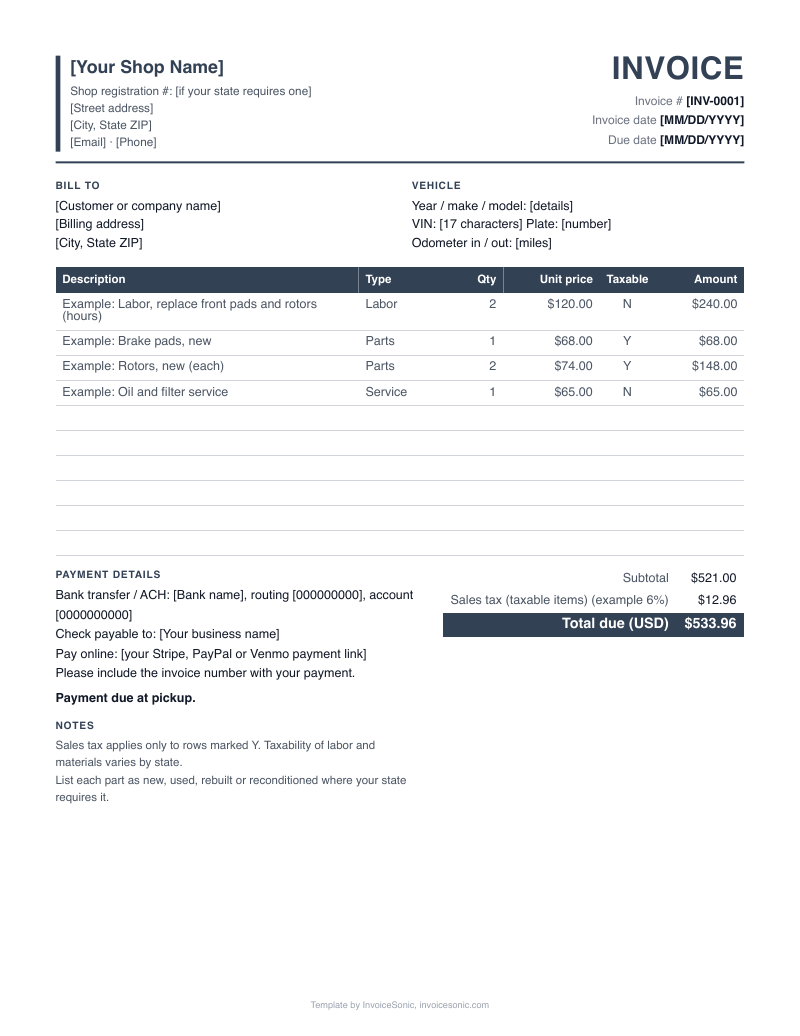
Download the auto repair invoice template
US Letter size, with labor, parts and taxable items already laid out. No email needed.
A file gets you one invoice. A free InvoiceSonic account saves your customers and line items for the next one.
What does an auto repair invoice look like? An example
Example only, with illustrative prices. A customer brings in a sedan with a battery warning light. The shop tests the charging system, gets approval on a written estimate, then replaces the alternator and worn belt. Labor is billed at 1.8 hours.
| Description | Qty | Price | Amount |
|---|---|---|---|
| Alternator, new, part no. in notes | 1 | $218.00 | $218.00 |
| Serpentine belt, new | 1 | $42.00 | $42.00 |
| Labor: charging system test, replace alternator and belt (hours) | 1.8 | $135.00 | $243.00 |
| Shop supplies | 1 | $18.00 | $18.00 |
| Total due | $521.00 | ||
- The top of the repair order would show year, make, model, VIN, plate and the odometer reading on arrival.
- Parts and labor are on separate lines, and each part says whether it is new. The customer can see where the money went.
- Sales tax is left at 0 here so you can enter your own rate. Which charges are taxed varies by state, so check yours before you set it.
Prices are illustrative. Use your own rates.
What should an auto repair invoice include?
An auto repair invoice should include the shop's details, the customer, the vehicle (VIN, plate, odometer), each part, labor hours and rate, shop supplies, sales tax and the total. It should also record what the customer complained of and what you found. That record protects you if the car comes back.
- Shop details
- Name, address and phone. Add your license or registration number if your state or customer requires it.
- Repair order number
- One number that ties together the estimate, the authorization and the final invoice.
- Customer details
- Name, phone and billing address. For fleets, add the account name and PO number.
- Vehicle details
- Year, make, model, VIN and plate. Take the VIN from the car, not from memory or an old record.
- Odometer
- Record the mileage in and out. It dates the repair and anchors any mileage-based warranty.
- Concern and findings
- Write the customer's complaint, the cause you found and the fix you made, in plain words.
- Parts
- Part description, part number, quantity, price and condition: new, used, rebuilt or reconditioned.
- Labor
- Describe each operation and show hours multiplied by your hourly rate.
- Totals and warranty
- Show subtotal, sales tax, total and amount paid, followed by your repair warranty terms and your signature line.
How do you charge for auto repair on an invoice?
Most shops charge parts at a marked-up price plus labor at a posted hourly rate. Labor hours come from a labor guide or from actual time. Small costs like shop supplies usually go on one extra line.
- Labor by the hour
- Hours multiplied by your rate. Say in your shop policy whether you bill book time or clock time, and use the same method on every job.
- Diagnostic fee
- Bill testing as its own line. If you credit it against the repair when the customer goes ahead, show that as a negative line.
- Parts and core charges
- List each part at your selling price. Where a core deposit applies, put it on a separate line and credit it when the old part goes back.
- Shop supplies
- This covers rags, cleaners and small consumables. Give it a clear label, keep it small, and check your state's rules on how it can be charged.
- Sublet work
- Work you send out, such as machine shop jobs or an alignment, goes on its own line with the vendor's work described.
How do you make an invoice for repairs?
To make an invoice for repairs, start from the signed estimate and the technician's notes. Add the vehicle details, list parts and labor separately, add supplies and tax, then explain the work in plain words. Go through it with the customer at pickup.
- 1
Open the repair order number and copy in the customer and vehicle details.
- 2
Enter the odometer reading and the customer's concern.
- 3
List each part with its number, condition, quantity and price.
- 4
Add labor by operation, with hours and rate.
- 5
Add shop supplies, sublet work and sales tax as separate lines.
- 6
Write the findings and warranty terms, record the payment, and have the customer sign.
Stop rebuilding this invoice for every job
Create a free account to save your customers and line items, email invoices from your phone or computer, and see what's been paid.
What auto repair invoice mistakes cost shops money?
The biggest losses come from unapproved work and vague records. If the invoice cannot show what was approved and what was done, the shop usually ends up giving money back.
- Doing added work on a verbal OK
- When a tech finds more, record who approved it, when and for how much. Keep that note with the repair order.
- Lump-sum pricing
- A single "brake repair" price invites a dispute. It also makes it hard to tell whether parts or labor made the margin.
- Skipping the outgoing odometer
- Without it, you cannot settle an argument about a mileage warranty or a test drive.
- Giving away diagnostic time
- An hour tracing a fault is billable work. If the customer declines the repair, you still have a diagnostic line to charge.
- Forgetting core credits
- Unclaimed cores are money left on the shelf. Track each one from the invoice until the supplier credits it.
Auto repair invoice FAQ
What is a car repair invoice?
A car repair invoice is the final bill for work on a vehicle. It lists the parts, the labor, any fees and tax, along with the vehicle details and the amount due. It also serves as the owner's service record.
What does a car repair invoice look like?
The top shows the shop, the customer and the vehicle, including VIN, plate and odometer. The middle lists parts and labor on separate lines. The bottom shows tax, the total, the warranty and a signature.
Are there legal rules for auto repair invoices?
Yes in some states, and they differ. California's Bureau of Automotive Repair is a strict example. Invoices there must itemize parts and labor, mark each part as new, used, rebuilt or reconditioned, show the shop's name, address and BAR registration number, and show sales tax separately. Customers must also authorize a written estimate before work starts. Check your own state's rules.
Is labor taxed on an auto repair invoice?
It depends on the state. Whether labor or a service is subject to sales tax varies, so do not assume the rate for parts also applies to labor. Keep the two on separate lines, then confirm with your state's tax agency.
What is the difference between a repair order and an invoice?
A repair order is the working document that opens the job and records the authorization and the work to be done. The invoice is the final bill. Many shops use a single document that becomes the invoice when the job closes, keeping the same number.
How do I bill an insurance or fleet job?
Add the claim number or fleet PO to the invoice, and show who pays what if the customer owes a deductible. Fleets often pay on terms such as net 30 by ACH or check. Confirm the terms before the first job.