Progress Invoice Template
Use this progress invoice template to bill a job in stages — list the contract sum, the percentage complete this period, previous payments and any retainage, and what is payable now. It works as a simple progress billing template for contractors and builders, and downloads as a PDF with no signup.
★★★★★ Rated by real users · No signup required · No watermark · Instant PDF download
Create your Progress invoice
Create a progress invoice with the contract sum, each work item’s value and percent complete, previous payments, retainage and approved change orders — the amount due this period calculates for you. Download a PDF in about 60 seconds, no signup.
Add your business, your client and your line items — totals calculate as you type, then download the PDF.
Create your Progress invoice →Completed progress invoice example
A progress invoice should let the client check each work item against the schedule of values before approving payment.
Project: Riverside kitchen remodel · Contract sum: $48,000 · Period: Sep 1–30, 2026 · Progress claim #3
Balance to finish including retainage: $25,860.00. Add approved change orders as separate lines with their change-order number.
Need the full guide? See progress billing or the worked progress billing example.
Free invoice generator for fast billing
Everything you need to bill like a business — nothing you don't.
Done in 60 seconds
Add your details and line items — totals, tax and formatting are handled for you. Download or send straight away.
No signup to start
Create and download your first invoice with no account, no watermark, no card. Sign up only when you want saved clients and tracking.
Get paid your way
List Progress, bank transfer, or card side by side. Payment-provider or bank fees may apply.
How to create an invoice online
Three steps from blank page to a professional PDF.
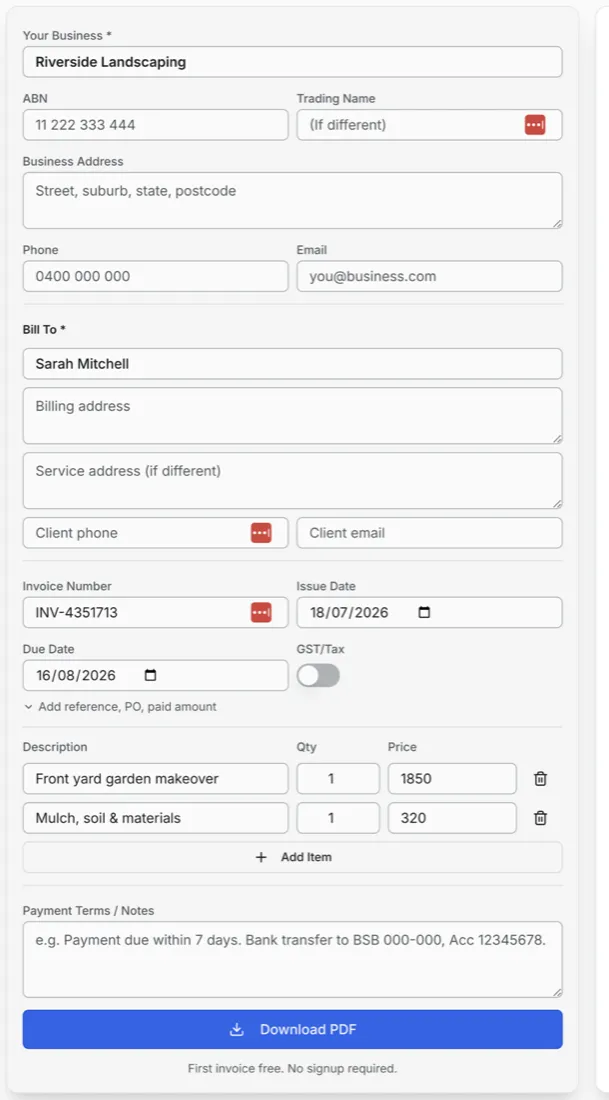
Step 1
Add your business and client details
Fill in who's billing and who's paying — that's the minimum a legally solid invoice needs.
- Your business and tax details — Use the business details and any tax identifier required for your location.
- Bill-to client details — Name is enough to start — add billing and service addresses for bigger jobs.
- Invoice number & dates — Auto-generated number, issue date and due date — editable if you have your own system.
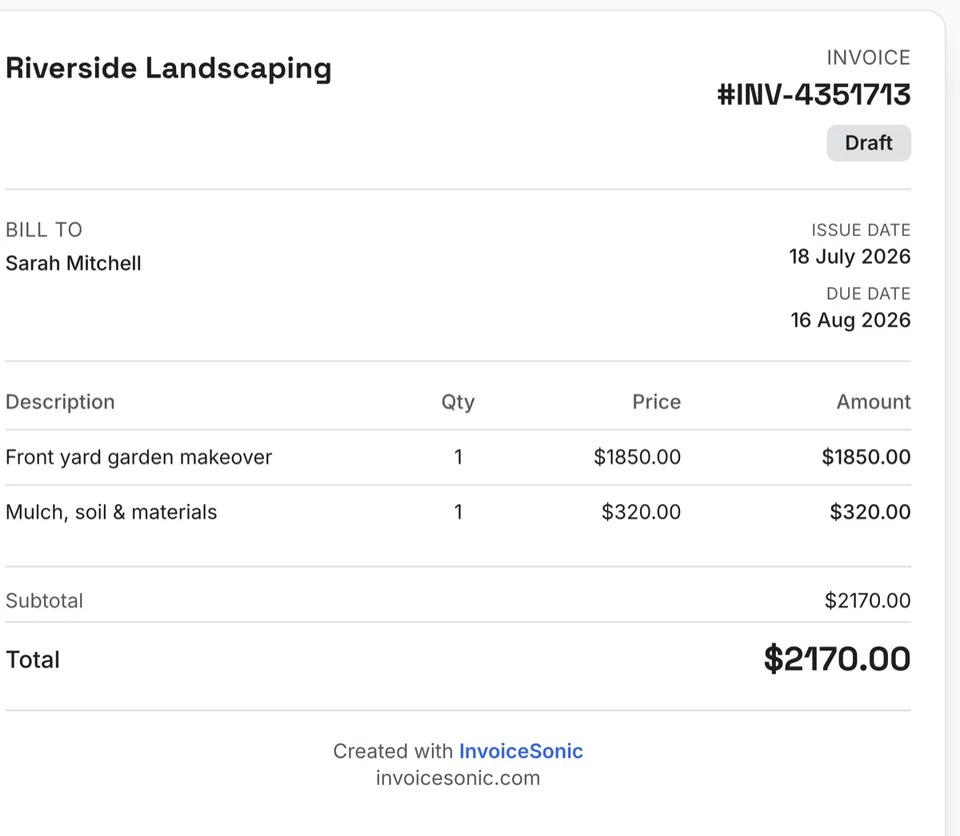
Step 2
Add line items — watch the invoice build itself
Every line you type appears instantly in a live preview of the finished invoice.
- Itemised lines with qty × price — Clear descriptions get approved (and paid) faster than lump sums.
- Totals calculated automatically — Subtotal, applicable tax and total update as you type — no broken spreadsheet formulas.
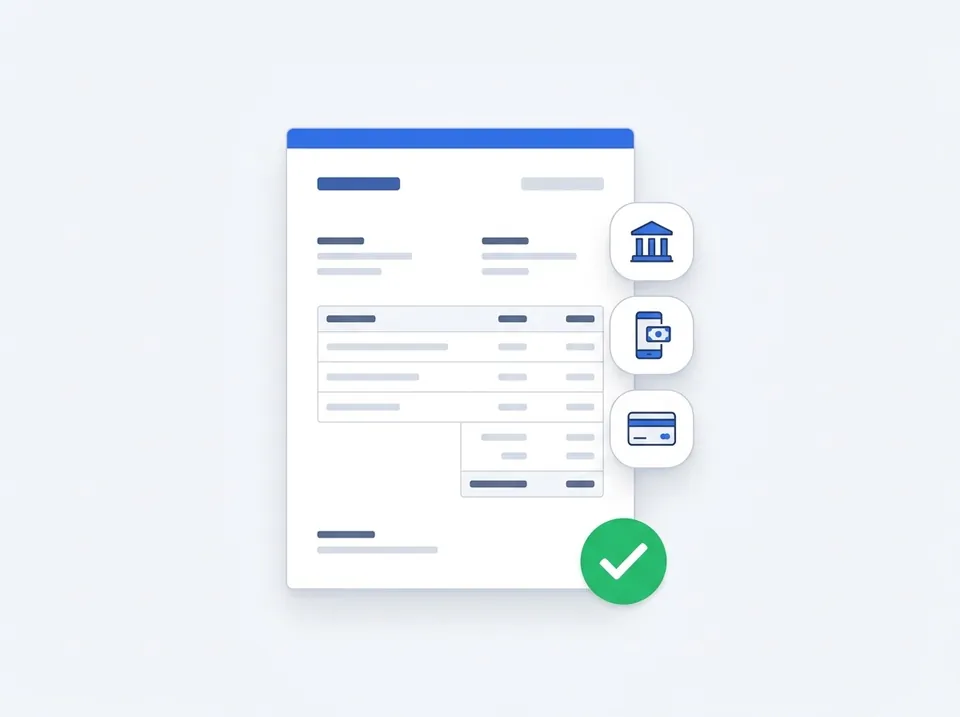
Step 3
Download, send, and get paid
Grab a clean PDF or email it directly. Your payment details go right on the invoice.
- Progress payment instructions — Use the correct business payment details and check any provider fees.
- Professional PDF, no watermark — A real record for your accountant, tax time, and any dispute.
- Payment terms on every invoice — Due dates and terms set the expectation — and speed up payment.
More than a one-off invoice
The free generator is the start. An InvoiceSonic account adds the tools that keep you paid all year.
Recurring invoices
Prepare repeat invoices on a schedule, then review and send.
Client & invoice storage
Every client and invoice saved and searchable — no more digging through Downloads.
Payment methods
Venmo, Cash App, Zelle, PayPal, bank details — saved once, on every invoice.
Applicable tax calculation
Toggle tax on and the maths is handled, line by line.
Send by email
Email invoices from the app with your details pre-filled.
Templates & branding
Multiple invoice styles with your logo and brand colours.
Fee calculator
See exactly what Venmo, Stripe, PayPal and Square take from every payment.
Track what's owed
Draft, sent, paid — know where every dollar is at a glance.
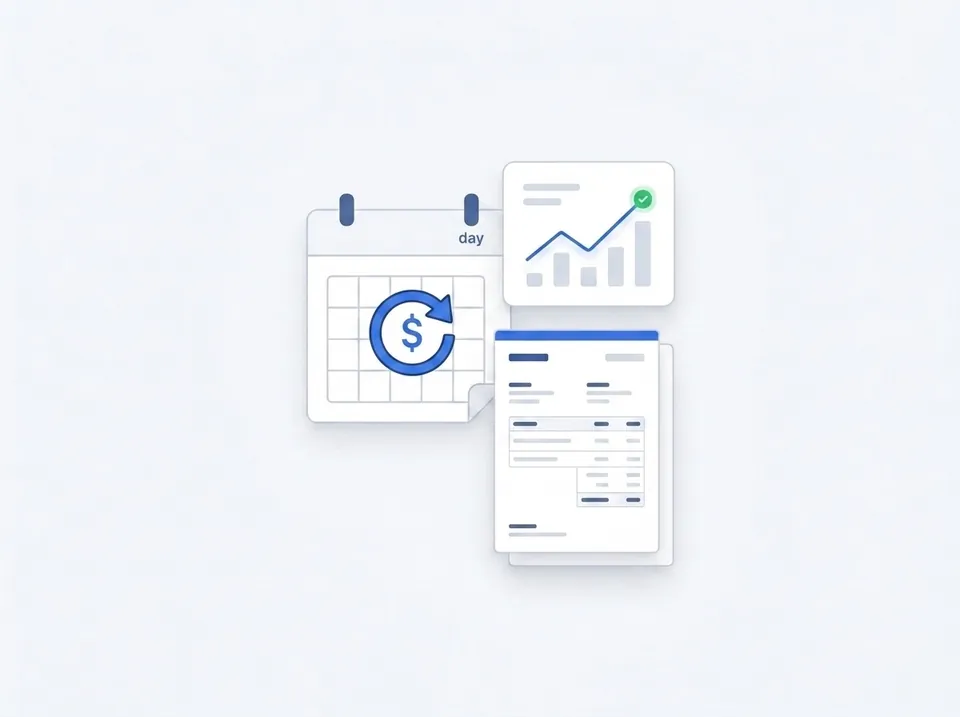
Prepare the next invoice without starting over
Prepare recurring invoices on schedule, review and send each one, then use payment records and eligible reminders to follow up outstanding balances.
- Recurring schedules — Choose a supported frequency, then review each generated invoice before sending.
- Outstanding-balance view — One dashboard showing every unpaid invoice and its due date.
- A record of everything — Exports ready for your accountant at tax time.
Free generator vs InvoiceSonic account
Start free forever. Upgrade only when the extra tools pay for themselves.
| Feature | Free generator | InvoiceSonic account |
|---|---|---|
| Professional invoice PDF | ✓ | ✓ |
| No watermark, no signup | ✓ | ✓ |
| Applicable tax calculation | ✓ | ✓ |
| Saved clients & invoices | — | ✓ |
| Recurring invoices | — | ✓ |
| Send & track by email | — | ✓ |
| Payment status tracking | — | ✓ |
| Your logo & branding | — | ✓ |
Why progress invoices get queried
A progress claim is checked line by line against the contract. If the client cannot see what was completed this period, payment stalls.
No schedule of values
Billing a round number each month without the contract sum broken into work items gives the client nothing to check percent complete against.
Previous payments and retainage missing
Every progress invoice should carry forward what has already been billed and paid, and show any retainage held back, so the balance payable is obvious.
Change orders buried in the total
Approved variations need their own lines with the change-order number; otherwise the contract sum no longer matches and the claim gets queried.
What to include on your progress invoice template
Australian tax invoices need these fields — our generator adds them automatically.
- ✓ Your business name, address, and ABN (if registered)
- ✓ Client name and billing address
- ✓ Unique invoice number and issue date
- ✓ Clear description of progress invoice services or products
- ✓ Line-item quantities, rates, and subtotal
- ✓ GST amount shown separately (if GST-registered)
- ✓ Total amount due and payment terms
- ✓ Payment details — BSB/account or payment link
How to use this progress invoice template
- ✓ Open the free invoice generator below — fields pre-match a standard progress invoice template
- ✓ Enter your business details and ABN once; they save for future invoices
- ✓ Add client information and line items for the work completed
- ✓ Review GST calculation and payment terms
- ✓ Download PDF or email the invoice directly to your client
Download in your format
Need Word, Excel, PDF, or Google Sheets? Use our free format templates — or create online and download PDF instantly.
Invoicing tools
Get paid your way
Related invoice templates
Same generator, set up for a different job.
More ways people search for this
These searches point to the same free invoice template — pick the wording your clients use.
- ✓ progress payment invoice template
- ✓ construction progress invoice
- ✓ contractor progress payment invoice
- ✓ schedule of values invoice
Progress invoice FAQ
What is a progress invoice?
A progress invoice bills part of a larger contract based on work completed during a period or at a milestone. Instead of one final bill, the contractor invoices in stages — for example at 25%, 50% and 75% complete — and the final payment covers the remaining balance and any released retainage.
What should a progress invoice include?
The project name and contract reference, billing period, a schedule of values listing each work item and its value, percent complete to date, amounts previously billed, retainage held, approved change orders, the amount due this period and the balance to finish.
How do I calculate what is owed on a progress invoice?
Multiply each line’s scheduled value by its percent complete to get work completed to date, subtract retainage, then subtract what you have already billed. For example: a $100,000 contract at 40% complete is $40,000; less 10% retainage ($4,000) is $36,000; less $20,000 previously billed leaves $16,000 due now.
What is retainage?
Retainage (or retention) is a percentage of each progress payment — often 5% to 10% — that the client holds back until the job is finished, as security against defects or incomplete work. It is released with the final payment under the terms of the contract.
Do I need AIA G702 and G703 forms?
Only if your contract requires them. Many commercial US projects use the AIA G702 application for payment with a G703 continuation sheet. Smaller residential and trade jobs usually accept a clear progress invoice that shows the same figures: schedule of values, percent complete, previous payments and retainage.
Can I use it for milestone billing?
Yes. List each milestone as a line item with its agreed value, invoice the milestones reached this period, and carry forward what has already been paid.
Why use progress invoicing?
Progress invoicing smooths cash flow on long jobs: you are paid as work is completed instead of waiting for the end. Agree a payment schedule in the contract, then send each progress invoice with your contact information, the payment due date and a unique invoice number so the invoicing process stays easy to audit.
Create your progress invoice template now
Free PDF download with country-ready tax, business ID and payment fields. No credit card required. Prefer to start from scratch? Use our invoice generator.
Start free — create invoice