How to Invoice as a Contractor
Last updated 8 September 2026 · By InvoiceSonic Team · 8 minute read
Quick answer
Use your business and customer details, the accepted job reference, specific work descriptions, correct tax treatment and the agreed due date. Keep amounts already invoiced separate from payments received. The worked AUD example below shows labour, materials and an approved extra.
Confirm the billing arrangement
An invoice records a business charge. It does not determine whether a worker is legally a contractor or employee. If you are unsure of your status, check the ATO guidance on contractors before treating wages as business invoices.
For a contractor job, identify the legal customer, service location, accepted scope and who approves payment. An accounts-payable address can be different from the person booking the work. Ask for the purchase order or job reference before sending.
Use InvoiceSonic invoicing for contractors to prepare the document and keep the job’s billing details together.
What an Australian contractor invoice should include
- Your business identity, contact details and ABN where applicable.
- The correct customer identity and billing address, plus service address where relevant.
- A unique invoice number, issue date and exact due date.
- Quote, contract or purchase-order reference.
- Specific work descriptions, quantities, rates and approved variations.
- Currency, applicable tax and the amount due on this invoice.
- Verified payment instructions and the payment reference.
For a tax invoice, include the seller’s identity and ABN, issue date, description and price, GST information and the extent to which the sale is taxable. Tax invoices for sales of A$1,000 or more also need the buyer’s identity or ABN. See the ATO tax-invoice requirements.
Contractor invoice example: an Australian service job
This fictional AUD example assumes a GST-registered contractor makes a wholly taxable sale at 10% GST. Prices were agreed before GST. Replace all example identities with your actual details; this is an annotated layout, not an invoice ready to send.
Tax invoice CON-2026-041
Seller: Example Contractor — [your registered ABN]
Buyer: Example Customer Pty Ltd
Project: Q-041, installation at Example Site
Issue date: 8 September 2026
Due date: 22 September 2026, under the accepted terms
| Description | Quantity × rate | Amount |
|---|---|---|
| Installation labour under Q-041 | 8 hours × A$100 | A$800 |
| Agreed materials | 1 × A$300 | A$300 |
| CO-01 extra preparation, approved 8 September | 2 hours × A$100 | A$200 |
| Subtotal before GST | A$1,300 | |
| GST at 10% | A$130 | |
| Total invoice | A$1,430 |
Scope reference: Q-041 links the base lines to the agreed work. Variation reference: CO-01 identifies the separately approved extra. Buyer identity: the example includes the customer’s business identity. Tax: A$1,300 × 10% = A$130; do not add GST again if your quoted price already includes it.
If you are not GST-registered, do not copy the tax-invoice heading or GST line. Your agreed price and applicable tax treatment determine the invoice. Start with the contractor invoice template and check the completed document.
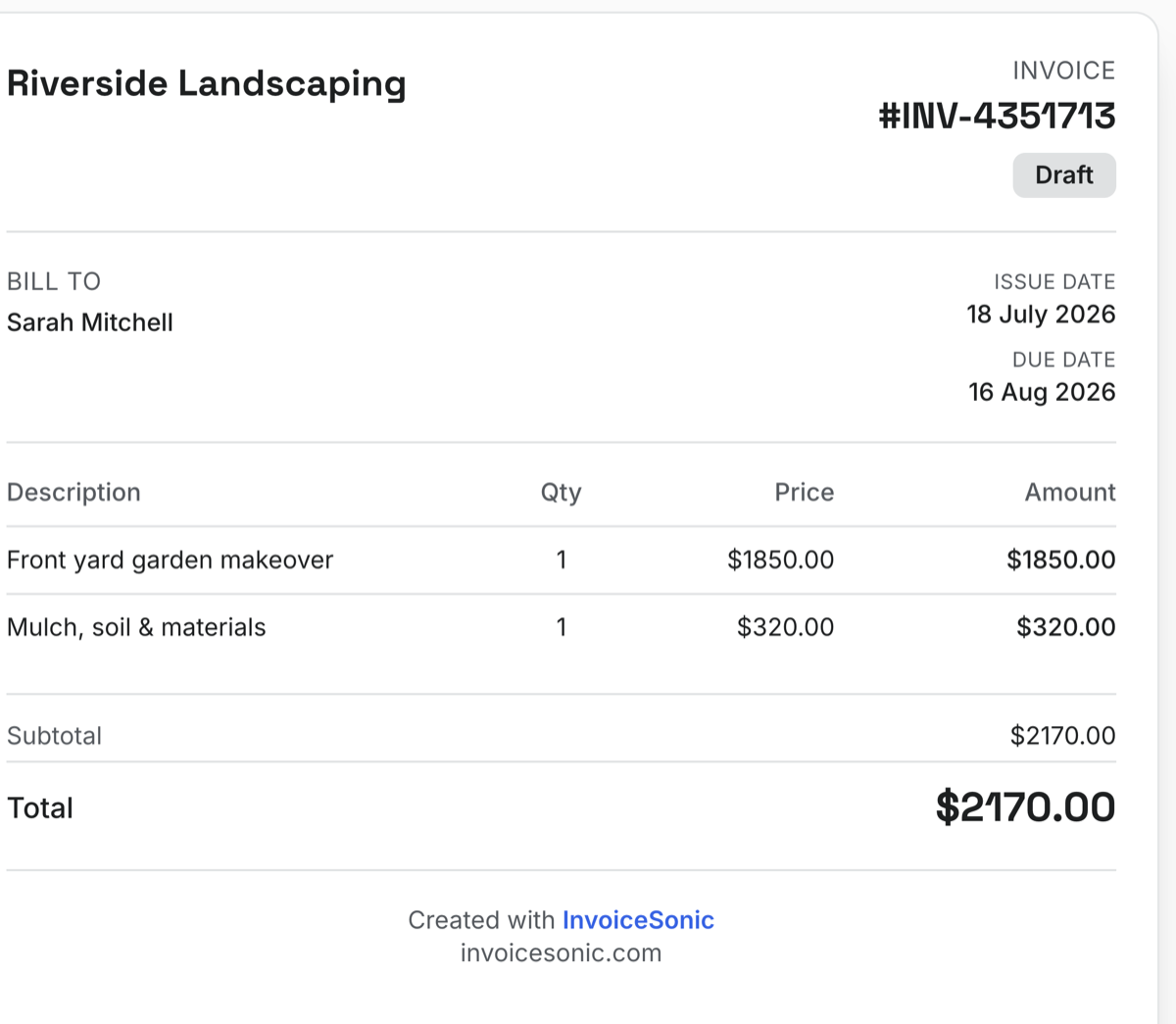
InvoiceSonic product screenshot. The AUD figures above are a separate fictional worked example.
ABN and withholding: check whether the rule applies
If a supplier does not quote an ABN, a business payer may need to withhold 47% unless an exception applies. An ABN can be quoted on another relevant document; its absence from one invoice does not automatically mean every customer must withhold. Check the ATO’s no-ABN withholding guidance for the circumstances and exceptions.
Where appropriate, provide your ABN before payment and keep the business identity consistent across the quote and invoice. Apply through the Australian Business Register if eligible. Do not use somebody else’s ABN or a fictional sample number.
GST for contractors
GST registration and holding an ABN are separate. The usual business registration threshold is A$75,000 GST turnover, assessed using the current and projected turnover rules; special rules can apply. The ATO explains when registration is required and the 21-day registration period in its GST registration guidance.
If you are registered, apply the correct GST treatment to the sale. Not every sale is taxable at 10%. If you are not registered, do not charge GST as though you were. The example above is deliberately a simple wholly taxable sale, not guidance on every transaction or deposit’s tax timing.
See what a tax invoice is for the document requirements, and check unusual transactions with your accountant.
Payment terms for contractor invoices
Use the deadline and payment method agreed before the work. Net 7, Net 14 and Net 30 are possible arrangements, not universal contractor standards. Write the exact due date on the invoice so the customer need not calculate it.
For example: “Payment for CON-2026-041 is due 22 September 2026 by bank transfer. Use CON-2026-041 as the payment reference.” Add your verified business account details. A payment instruction is not evidence that the money has arrived.
Do not assume a late-fee clause is enforceable just because it appears on the invoice. Check the agreement and applicable rules. For larger jobs, verify local deposit and construction-payment requirements before choosing a percentage.
Use the contractor payment-terms examples and payment-schedule guide to separate the invoice trigger from the deadline for paying it.
Deposits, progress invoices and the final balance
For a single full-value invoice, record a partial payment against that invoice. In the A$1,430 example, a confirmed A$330 payment leaves A$1,100 outstanding. Do not issue another A$1,100 charge for the same work.
If you instead issue separate deposit and remaining-scope invoices, their combined charges must equal the agreed project value. Keep earlier billing separate from payments received. Tax timing and credits need to follow the treatment appropriate to the transaction; a payment should not be disguised as a negative sale line.
The deposit and final-invoice guide shows both methods. For staged projects, the progress-billing example distinguishes billed, paid, outstanding and unbilled amounts.
Record any approved change orders separately. On repeat monthly work, state the service period and agreed scope on each invoice. Keep unique invoice numbers and stop reminders once payment has been confirmed and recorded.
Frequently asked questions
How do I invoice as a contractor in Australia?
Identify the customer and agreed scope, add your business details and ABN where applicable, describe the work, apply the correct tax treatment and show the agreed due date and payment instructions. Preview the invoice before sending.
Do I need an ABN to invoice as a contractor?
Check your ABN entitlement and provide it where applicable. A business payer may need to withhold if an ABN is not quoted, but exceptions apply and the ABN can be supplied on another relevant document.
Do I need to charge GST as a contractor?
GST registration and the tax treatment of the sale determine whether GST is charged. Do not charge GST if you are not registered. Check the current and projected GST-turnover rules to determine registration obligations.
How do I invoice as a contractor without an ABN?
Establish whether you are eligible for an ABN and whether the no-ABN withholding rules apply to your transaction. Check the ATO guidance and relevant exceptions before requesting payment.
How do I write an invoice as a contractor?
Use specific line items with quantities and rates, a quote or project reference, separate approved extras, correct tax and a clear amount due. The worked example in this guide shows an Australian labour-and-materials invoice.
What payment terms should a contractor use?
Use terms agreed before the work and permitted by the applicable rules. Show an exact due date and payment method. There is no universal Net 14 term or deposit percentage for all contractor jobs.
Can a contractor invoice be a tax invoice?
A GST-registered contractor must follow tax-invoice requirements for relevant taxable sales. These include seller identity and ABN, date, sale and GST information; sales of A$1,000 or more also need buyer identity or ABN.
How often should a contractor invoice?
Follow the agreed job milestones or billing period. A short job may be billed on completion; a longer one may use progress invoices. Keep each new charge distinct from earlier invoices and payments.
Related guides
Skip the writing — use the generator
Pre-built phrasing, all required fields, PDF in under a minute. Free, no signup.
Open invoice generator →